はじめに
When a laser diode needs to maintain its wavelength stability within a fraction of a nanometer, or when a medical diagnostic cycler must complete dozens of rapid heating and cooling cycles per hour, conventional compressor-based cooling systems quickly reach their limits. In these scenarios, where both speed and precision are critical, the TECチップ (thermoelectric cooler chip) emerges as a far more effective solution.
Unlike bulky mechanical refrigeration systems that depend on compressors, refrigerants, and moving parts, TEC chips utilize the ペルティエ効果 to deliver rapid, solid-state temperature control. This allows for millisecond-level response times and temperature stability as precise as ±0.01°C, all within a compact, silent, and vibration-free design.
In this article, we will explore how a TEC chip works, why it can outperform traditional cooling methods in precision applications, and how it is enabling advancements across industries ranging from optoelectronics and medical diagnostics to electric vehicle systems.
Understanding the TEC Chip — How a Small Solid‑State Device Creates Instant Cooling
The Peltier Effect Explained in Simple Terms
At the heart of every TECチップ lies a principle discovered by Jean‑Charles Peltier in 1834. When a direct current (DC) flows through a circuit made of two dissimilar conductors, one junction absorbs heat (the cooling side) while the other junction releases heat (the hot side). Modern thermoelectric modules replace simple metal wires with dozens or hundreds of semiconductor “couples” — typically bismuth telluride (Bi₂Te₃) pellets — arranged electrically in series but thermally in parallel.
When DC voltage is applied, electrons move from the negative to the positive terminal. As they cross from a p‑type to an n‑type semiconductor pellet, they absorb lattice heat energy at the cold junction. After travelling through the circuit, they release that energy as waste heat at the hot junction. The result: one face of the TECチップ becomes cold (sometimes below -50°C), while the opposite face becomes hot, ready to be dissipated by a heat sink and fan.
Because there are no compressors, expansion valves, or refrigerants, a TECチップ is sometimes called a “solid‑state” heat pump. Its simplicity is its superpower: only electrical current controls the temperature, and reversing the current instantly swaps the hot and cold sides — enabling both heating and cooling from the same device.
Key Components Inside a TEC Chip
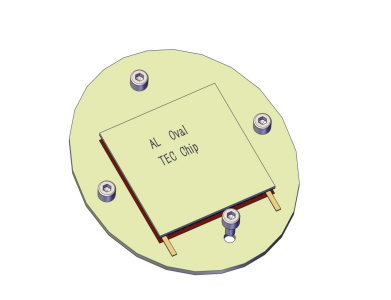
A typical thermoelectric cooler chip consists of:
-
Semiconductor pellets (p‑type and n‑type Bi₂Te₃) – typically 1.0 mm × 1.0 mm × 1.2 mm each.
-
Metal interconnects – usually copper or aluminum, bonding pellets in series.
-
セラミック基板 – high‑purity alumina (Al₂O₃) or aluminum nitride (AlN), providing electrical insulation and structural rigidity.
-
Sealing (optional) – epoxy or silicone edge seal to prevent moisture ingress in high‑humidity environments.
-
Lead wires – for DC power input and optional thermistor feedback.
How Fast Is “Fast”? — Response Time and Settling
Unlike compressor cycles that take seconds to minutes to alter temperature, a properly driven TECチップ can achieve a notable heat‑pumping effect in under 100 milliseconds. Because the heat transfer occurs directly at the atomic level, there is no thermal inertia from a circulating refrigerant. Under closed‑loop PID control, a TEC can go from +25°C to +5°C in less than 2 seconds (for a small‑form‑factor chip) and reach ±0.01°C setpoint stability within 1–3 seconds. This speed advantage is why TEC devices are the standard for laser diode temperature stabilization, where wavelength drift of 0.3 nm/°C must be eliminated in real time.
The Performance Metrics That Define a Quality TEC Chip
To evaluate a thermoelectric module, engineers look at several key parameters. Below is a summary of typical ranges for a standard single‑stage TEC chip (e.g., 40 × 40 mm footprint, 127 couples).
| パラメータ | Typical Value | Significance |
|---|---|---|
| Maximum temperature difference (ΔTmax) | 65 – 75°C (at hot side 27°C, vacuum) | Determines how cold the cold side can get relative to the ambient. |
| Maximum cooling power (Qmax) | 10 – 150 W (depending on size) | How much heat can be actively pumped from the cold side? |
| Maximum operating current (Imax) | 2 – 15 A | The current that achieves ΔTmax. Derate for lower current. |
| Maximum voltage (Vmax) | 5 – 30 V (DC) | Voltage at Imax. |
| Thermal resistance (ceramic to pellet) | 0.5 – 2 K/W | Lower is better for heat transfer efficiency. |
| AC resistance (module ohms) | 0.5 – 12 Ω | Typical resistance at room temperature. |
| Wire gauge/length | 20 AWG, 200 mm (common) | For safe current delivery. |
A high‑quality TECチップ used in medical or aerospace applications may achieve ΔTmax > 75°C with dual‑stage or multistage modules (cascaded chips), reaching cold side temperatures of -80°C to -100°C.
Coefficient of Performance (COP) — The Efficiency Reality
At first glance, a Peltier module is less energy‑efficient than a large compressor system. Typical COP for a TEC at full cooling load ranges from 0.4 to 0.7 (compared to 2–4 for a compressor). However, such simple comparisons miss the point: TEC technology excels where compressor cooling cannot be used at all (small form factor, no vibration, instant response) or at very low cooling power (under 20 W). For point‑of‑need thermal management, the TEC chip offers an unbeatable power‑density‑per‑volume ratio.
Expert note: When operating at 30 % of Imax, a TEC chip’s COP can rise to 1.0–1.5, making it surprisingly efficient for moderate temperature differentials (ΔT < 20°C).
TEC Chip vs. Traditional Compressor Cooling — A Feature Table
To understand where a thermoelectric cooler is truly superior, compare it side‑by‑side with conventional refrigeration.
| Feature | TEC Chip (Solid‑State) | Compressor‑Based System |
|---|---|---|
| Temperature accuracy | ±0.01°C or better (with PID) | ±1°C (typical) |
| Response time | < 0.5 second to 90% setpoint | 5 – 30 seconds |
| Size & weight | Extremely compact (2 – 30 mm thin) | Bulky (compressor, condenser, evaporator) |
| Moving parts | None (zero vibration, silent) | Compressor fans, valves (audible noise, vibration) |
| Reliability (MTBF) | > 100,000 hours (solid‑state) | ~10,000 – 50,000 hours (moving parts wear) |
| Both heating + cooling | Yes (reverse current) | No (heating requires a separate element) |
| Refrigerant | None (environmentally benign) | HFCs / HCFCs (greenhouse concerns) |
| Applicability to micro‑devices | Excellent (fits inside small enclosures) | Impractical |
| DC operation | Native (12 V, 24 V, 48 V) | Usually needs an AC inverter |
| Cost per watt of cooling | Higher for large loads | Lower for large loads (>200 W) |
The takeaway: For applications under ~150 W of cooling requirement, a TECチップ is nearly always the superior choice — and sometimes the only feasible one.
Real‑World Applications: Where a TEC Chip Makes the Difference
The unique combination of fast response, precise setpoint control, and miniature footprint has made thermoelectric modules indispensable in dozens of industries. Below are some of the most impactful use cases.
Laser Diode and Optical Module Temperature Stabilization
Laser diodes used in fiber‑optic communication, medical surgery, and industrial cutting have strict wavelength stability requirements — sometimes within ±0.01 nm. Because wavelength shifts about 0.3 nm/°C for many InGaAsP lasers, even a 0.1°C drift causes signal degradation. A TECチップ placed directly under the laser submount, driven by a precision current controller, keeps the laser at a fixed temperature (often 25°C or 45°C) regardless of ambient fluctuations. Optical transceivers (SFP, QSFP) universally incorporate tiny Peltier modules to cool or heat the laser chip.
PCR and Medical Diagnostic Instruments
Polymerase Chain Reaction (PCR) amplifies DNA through 30–40 thermal cycles between 55°C and 95°C. A thermoelectric cooler is the ideal actuator for the heating‑cooling block: it can heat (by reversing current or adding a resistive heater) and then rapidly cool (~3 °C/s) to anneal primers. Real‑time PCR systems demand temperature uniformity across 96 or 384 wells within ±0.1°C — a precision only achievable with well‑designed TEC chips and feedback control. Many modern medical diagnostic platforms also use TEC chips for reagent storage (maintaining 2–8°C inside a compact cartridge).
Automotive — EV Battery Thermal Management and Seat Cooling
Electric vehicle (EV) battery packs generate significant heat, especially under fast charging. While large HVAC systems handle cabin and main pack cooling, some high‑end EVs use thermoelectric modules for spot cooling of battery management system (BMS) electronics, lidar sensors, or power inverters where fast, local temperature adjustments are required. Additionally, automotive seat climate systems (ventilated seats with active cooling) deploy TEC chips in the seat back and cushion — delivering instantaneous cooling from 12 V vehicle power without compressor noise or weight.
Consumer Electronics and Photonics
-
Beam splitters and CCD/CMOS sensors: Scientific cameras use TEC chips to cool the image sensor below ambient, drastically reducing dark current noise for long‑exposure astrophotography.
-
Miniature refrigerators and wine coolers: Small 4‑ to 20‑bottle thermoelectric wine coolers rely entirely on TEC modules — quiet, vibration‑free, and able to maintain a constant 12–14°C.
-
PCR cyclers for point‑of‑care: Handheld COVID‑19 or flu diagnostic devices integrate a micro‑TEC chip for rapid heating‑cooling cycles without laboratory infrastructure.
Industrial and Telecom Enclosures
Outdoor telecom cabinets (5G base stations) are exposed to extreme heat in summer. A thermoelectric cooler assembly mounted on the cabinet door or side wall keeps internal temperature below 65°C, protecting sensitive RF and processing boards. Because TEC chips work equally well for heating, the same module can warm the enclosure in winter (avoiding condensation). There are no filters, compressors, or refrigerant lines to fail — a huge reliability boost for remote sites.
How to Integrate a TEC Chip Into Your Thermal Design — Practical Guidelines
Selection Criteria — Matching the TEC to Your Load
Choosing the correct Peltier module involves three steps:
-
Determine ΔT: the difference between the desired cold side temperature and the ambient/hot side temperature (e.g., cool laser to 22°C when ambient is 45°C → ΔT = 23°C).
-
Calculate heat load (Qc): the total thermal power (in watts) that must be removed from the cold side: product self‑heating + external heat inflow + any active heat generation.
-
Select a TEC chip where Qmax (at the operating ΔT and current) is at least 1.2 × Qc for safety margin.
Most manufacturers provide performance curves (Qc vs. ΔT at varying currents). A common mistake is underestimating the “hot side” temperature: if the hot side exceeds 80°C, many TECチップ degrade permanently.
Heat Sinking Is Non‑Negotiable
A TECチップ pumps heat from the cold to the hot side, but that waste heat must be efficiently rejected into the environment. Without an adequate heat sink + fan (or liquid cold plate), the hot side temperature rises, reducing ΔTmax and eventually causing thermal runaway. Rule of thumb: the heat sink should keep the hot side within <50°C for standard modules. For high‑power TEC applications (e.g., 100 W), a forced‑air heat sink with thermal resistance <0.3 K/W is mandatory.
Drive Electronics — PID Controllers, Not Simple On/Off
To achieve the famous ±0.01°C accuracy, a TECチップ must be driven by a closed‑loop controller that reads a thermistor or RTK sensor embedded in or near the cold object. Pulse‑width modulation (PWM) plus a linear current driver minimizes thermal ripple. Many OEMs use dedicated TEC controller ICs (e.g., ADN8834, MAX1968) that combine H‑bridge output, proportional‑integral‑derivative (PID) compensation, and voltage/current monitoring. Never connect a TEC chip directly to a battery or uncontrolled supply — large inrush current will damage the semiconductor pellets.
Reliability, Lifespan, and Common Failure Modes
Solid‑State Means Long Life — With Caveats
When operated within specified current, voltage, and temperature limits, a thermoelectric module has a mean time between failures (MTBF) exceeding 200,000 hours (>20 years). The main wear mechanisms are:
-
Thermal cycling stress: repeated expansion/contraction of solder joints inside the module can cause micro‑cracks after 100,000+ cycles. Advanced manufacturers use “high‑temperature solder” (melting point >250°C) to improve cycle life.
-
Moisture ingress: condensation inside the TEC chip corrodes bismuth telluride pellets. A hermetic edge seal (epoxy or silicone) is essential for humid environments.
-
Overcurrent / ESD: applying more than Imax causes local melting of the semiconductor matrix, permanently reducing cooling capacity.
-
Mechanical over‑torque: mounting the TEC chip with uneven pressure or excessive screw torque cracks the ceramic substrate.
Real‑World Field Data
In telecom outdoor enclosures with proper sealing and active hot‑side cooling, TECチップ routinely operate for 15+ years with minimal degradation. PCR instrument manufacturers report mean cycles‑to‑failure > 500,000 thermal cycles, thanks to improved solder and ceramic interfaces. For most industrial applications, the TEC chip outlasts the product it cools.
Recent Innovations and Future Directions in TEC Chip Technology
Bismuth Telluride Alternatives
Research into P‑type skutterudites and Mg₂Si‑based materials aims to increase the figure of merit (ZT) beyond the current 1.0–1.2 for Bi₂Te₃. A ZT > 1.5 would allow a TECチップ to achieve the same ΔT with 50% less power consumption, making solid‑state cooling viable for mainstream consumer appliances.
Thin‑Film and Micro‑TEC Chips
For chip‑scale photonics and wearable devices, ultra‑thin thermoelectric coolers (thickness <0.5 mm) are fabricated using semiconductor deposition techniques. These micro‑TEC chips are integrated directly inside laser packages (butterfly packages) or even on‑chip for hot‑spot cooling of CPUs.
Integration with Two‑Phase Cooling
Some leading‑edge thermal management systems pair a thermoelectric chip with a miniature vapor chamber or heat pipe to reduce hot‑side thermal resistance even further, achieving effective cooling densities beyond 200 W/cm² — ideal for high‑power laser diode arrays and graphics processors.
FAQ
Q1: Can a TEC chip both heat and cool using the same polarity?
No. Heating requires reversing the DC polarity. Many TEC controllers include an H‑bridge for bi‑directional current.
Q2: How accurate is a typical TEC chip temperature control system?
With a precise PID controller and a calibrated thermistor, accuracy of ±0.01°C is standard — for demanding applications, ±0.001°C is possible.
Q3: Do TEC chips waste a lot of electricity?
They are less efficient than large compressors at high cooling loads (>100 W). However, for small loads and fast response, the total energy consumption is often lower.
Q4: What is the maximum cooling temperature difference from a single TEC chip?
From a hot side at 27°C, ΔTmax is usually 65°C – 75°C. For colder temperatures (‑80°C), multi‑stage cascaded TEC modules are used.
Q5: How do I choose between TEC and refrigeration for my product?
Use TEC if you need silent operation, no vibration, compact size, fast temperature cycling, or cooling/heating from one device. Use compressors only for large volume cooling >200 W.
結論
From stabilising a medical laser’s wavelength to running 40 rapid PCR cycles per hour, the TECチップ has proven itself as the most agile, accurate, and reliable solid‑state thermal actuator available today. It eliminates the compromises of compressor‑based systems — bulky size, slow response, vibration, and refrigerant concerns — while delivering temperature control precision down to ±0.01°C. Whether you are designing next‑generation 5G optics, an EV battery spot‑cooling system, or a compact point‑of‑care diagnostic device, integrating a high‑performance thermoelectric cooler module will elevate your product’s reliability and functionality.
Ready to Integrate a TEC Chip Into Your Design?
We can help you select the right Peltier module — from standard 40 × 40 mm single‑stage chips to custom multi‑stage cascade arrays complete with thermal analysis and drive electronics recommendations.