はじめに
Thermoelectric cooler chips are quietly replacing compressor-based refrigeration in demanding applications—from laser diodes in 5G systems and PCR diagnostic equipment to EV battery thermal management. By eliminating moving parts, refrigerants, and vibration, TEC technology addresses reliability and precision challenges that traditional compressors struggle to solve.
The global thermoelectric cooler market reflects this shift. It was valued at about USD 3.8 billion in 2024 and is projected to reach USD 5.6 billion by 2031, growing at a CAGR of 5.8%. A more focused segment tracking semiconductor-based thermoelectric cooling shows even faster growth—from USD 917 million in 2025 to USD 1.55 billion by 2031, at 9.1% CAGR.
In short, this isn’t a niche upgrade—it’s a steady shift driven by one core gap: modern electronics increasingly demand cooling that is smaller, quieter, and more precise than conventional compressor systems can provide.
How a Thermoelectric Cooler Chip Actually Works (And Why It Matters for Your Design)
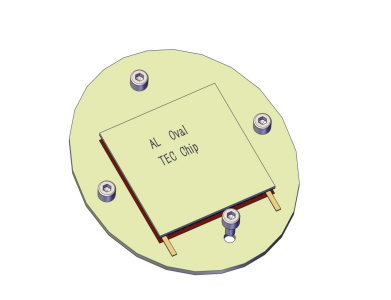
Understanding the Peltier effect is essential before comparing performance metrics. A thermoelectric cooler chip consists of multiple alternating p-type and n-type semiconductor elements—typically bismuth telluride (Bi₂Te₃)-based materials—connected electrically in series and thermally in parallel, sandwiched between two ceramic substrates. Each thermoelectric cooler chip acts as a solid‑state heat pump with no moving parts.
When DC flows through the circuit, electrons move from a lower energy state in the p-type material to a higher energy state in the n-type junction, absorbing heat at the cold side. At the opposite junction, energy is released as electrons return to a lower energy level. This simple electron transport mechanism enables bidirectional operation: reverse the current polarity, and the chip switches instantly from cooling to heating.
This design carries profound engineering implications. No compressor means no mechanical wear. No refrigerant means no leak paths, no environmental compliance overhead, and no moving parts to fail. The ceramic encapsulation protects the semiconductor elements from environmental contaminants while providing electrical isolation.
The key parameters engineers examine when selecting a thermoelectric cooler chip include ∆Tmax (maximum temperature differential), Qmax (maximum heat pumping capacity at ∆T = 0), Imax (optimal operating current), and Vmax (corresponding voltage). A single-stage module might achieve ∆Tmax of 70–80°C at 27°C hot-side temperature—sufficient for most precision cooling applications. For deeper cooling down to –80°C or lower, multistage configurations stack multiple chips to achieve ∆T values of 100–120°C in vacuum environments, typically used in infrared sensors and X-ray detectors.
The ΔT / COP Trade‑Off You Need to Understand
Most engineers encounter thermoelectric cooling technology with a common concern: low efficiency. It‘s a valid concern, but the full story is more nuanced. A thermoelectric cooler chip’s coefficient of performance (COP)—cooling power divided by input electrical power—varies dramatically with operating conditions. Running a module near its maximum ∆T pushes COP below 0.5. But operating at lower temperature differentials—say, ∆T below 30°C—can achieve COPs approaching 1.0 or higher. Research indicates maximum COP for TEC systems typically occurs at currents of 3–4 amps, corresponding to a ∆T of approximately 28°C.
Compare this to vapor-compression systems: at full load, a well-designed compressor achieves a COP between 2 and 4. But here‘s what the headline number misses. At part-load conditions, traditional compressors cycle on and off inefficiently. Thermoelectric devices, by contrast, operate proportionally—cooling output scales linearly with current. This enables thermoelectric cooler chip assemblies to consume up to half the power of compressor-based units under proportional control in certain test conditions, while providing far tighter temperature stability. For cooling capacities in the tens of watts—the sweet spot for electronics cooling—TEC efficiency actually exceeds that of scaled-down compressor systems.
Eliminating Failure Points: Why Solid‑State Changes the Reliability Equation
Traditional compressor cooling systems contain three fundamental components: an evaporator for heat absorption, a compressor for refrigerant pumping, and a condenser for heat expulsion. Each introduces failure mechanisms—refrigerant leaks, mechanical wear, electrical overload on startup, moving parts that require lubrication, and vibration that loosens connections over time.
A thermoelectric cooler chip removes every single one of these failure points. Because the thermoelectric cooler chip is fully solid‑state, there is no lubrication schedule, no refrigerant recharging, and no compressor to seize.
The solid-state construction—essentially just semiconductor pellets, metal interconnects, and ceramic plates—undergoes rigorous validation. High-quality modules are tested to 1,000,000 thermal cycles, demonstrating exceptional long-term stability. With no moving parts, no refrigerants, no sliding seals, and no lubrication requirements, the Mean Time Between Failures (MTBF) dwarfs what conventional systems can achieve. Field performance data indicates that thermoelectric coolers with integrated PID controllers routinely exceed 70,000 hours of continuous operation, without the stress damage associated with compressor cycling.
Silent Operation as a Technical Requirement
In medical imaging, scientific instrumentation, and consumer electronics, noise is not merely an annoyance—it‘s a performance constraint. Compressor-based refrigeration generates audible noise from the compressor motor, refrigerant flow, and expansion valve. In MRI rooms, hospital diagnostic labs, and precision optical benches, background vibration disrupts measurements. A thermoelectric cooler chip produces no audible noise and negligible vibration—period. This alone justifies their adoption in sensitive instrumentation.
How Thermoelectric Cooler Chips Are Being Deployed Across Industries
The versatility of thermoelectric cooling technology continues to surprise even experienced thermal engineers. Applications now span automotive, medical, telecommunications, consumer electronics, aerospace, and scientific research, often in ways that compressors cannot physically fit or legally comply with.
Optical Communications and 5G/6G Infrastructure: High-speed laser diodes and optical transceivers demand exceptional temperature stability to prevent wavelength drift. In DWDM systems, a 1°C shift can change laser output wavelength by approximately 0.1 nm, which degrades signal integrity. Each thermoelectric cooler chip stabilizes these components precisely, enabling the dense wavelength division multiplexing that underpins modern fiber networks. The explosive growth of 5G base stations and optical modules has driven demand for micro TECs specifically, as pointed out at recent semiconductor cooling industry forums.
Medical and Laboratory Instrumentation: Polymerase chain reaction (PCR) diagnostic equipment cycles through precise temperature plateaus—typically denaturation at 94–98°C, annealing at 50–65°C, and extension at 72°C. Thermoelectric coolers achieve these rapid thermal cycles (±0.01°C stability) without the lag, overshoot, or contamination risks of liquid-based systems. Portable vaccine cold-chain transport, laser therapy devices, and analytical spectrometers similarly depend on TEC reliability.
Electric Vehicles and Automotive Climate Control: Modern EVs generate significant heat in battery packs, power electronics, and inverters. While main-battery thermal management still relies on liquid cooling loops, localized spot cooling for sensors, control modules, and cabin features increasingly uses thermoelectric coolers. Ventilated seats, heated/cooled cupholders, and autonomous driving sensor packages benefit from the compact form factor and bidirectional capability. A properly selected thermoelectric cooler chip fits directly behind a sensor housing or under a seat cushion—impossible for any compressor.
Consumer Electronics and Wearables: Smartphone performance cores, AR/VR headsets, and compact gaming devices generate intense localized heat that throttles processors. Miniaturized TECs provide spot cooling at the chip level. A landmark 2025 study in Nature Communications demonstrated a Mg₃Bi₂-based micro thermoelectric cooler achieving 5.7 W/cm² cooling power density with response rates up to 65 K/s, highlighting the rapid material science advances making chip-scale cooling practical. Thermoelectric modules also appear in portable mini refrigerators, wine coolers, and camping electric coolers, where silent operation outweighs energy efficiency considerations.
Aerospace and Defense: Infrared detectors, satellite optical benches, and spacecraft electronics operate in environments where compressors cannot function—zero gravity, vacuum, extreme vibration during launch. A thermoelectric cooler chip is inherently space-compatible: no fluids to leak, no compressors to wear, no orientation constraints. Multistage TECs achieve deep cooling to –80°C for detector noise reduction without mechanical complexity.
Data Centers and High-Performance Computing: AI accelerators and high-performance processors generate localized heat fluxes exceeding 1 kW/cm²—far beyond what air cooling can manage. Cold-plate liquid cooling works for overall chip cooling, but micro TECs enable targeted hotspot management by independent control of specific regions on a chip. For data center operators facing power usage effectiveness (PUE) pressures, hybrid cooling architectures combining liquid loops with TEC spot cooling represent a promising path forward.
Thermoelectric Cooler Chip vs. Compressor‑Based Cooling: A Side‑by‑Side Comparison
The choice between a thermoelectric cooler chip and a compressor depends entirely on your application‘s priorities. Neither technology is universally superior. But for precision electronics cooling, portable medical devices, and zero-maintenance installations, the advantages of thermoelectric cooler chips increasingly outweigh the efficiency trade-offs.
| Feature | Thermoelectric Cooler Chip | Compressor-Based Cooling |
|---|---|---|
| Moving Parts | None (fully solid-state) | Compressor, expansion valve, fans |
| Refrigerants | None (electrical only) | Requires HFCs, HCFCs, or hydrocarbons |
| Vibration and Noise | Zero vibration, no audible noise | Motor hum, refrigerant flow, valve clicks |
| Temperature Precision | ±0.01°C achievable with PID control | Typically ±1–2°C, cycles produce overshoot |
| Bidirectional Operation | Instant heating/cooling by reversing current | Separate heating and cooling systems required |
| Lifespan and Reliability | 70,000+ hours, tested to 1M cycles | 7–15 years is typical; compressors wear out |
| Low‑Capacity Efficiency (under 100W) | High efficiency relative to the needed cooling | Poor efficiency when scaled down |
| High‑Capacity COP (over 500W) | Lower COP (0.4–0.7 typical) | Higher COP (2.0–4.0) |
| Physical Footprint | Compact, under 10mm height, fits tight spaces | Requires space for the compressor and refrigerant lines |
| Installation and Orientation | Any orientation, unaffected by gravity | Must be level; refrigerant flow orientation matters |
| Maintenance | None (sealed, no moving parts) | Periodic checks, refrigerant recharge, and filter replacement |
| Environmental Compliance | No regulatory restrictions | Phase‑down regulations for refrigerants |
This table tells a clear story: for high-capacity, low-precision, large-scale cooling, compressors remain the economically rational choice. But for compact devices, precision control, mobility, and applications requiring silent, vibration-free operation, thermoelectric cooler chips are pulling decisively ahead.
Here’s another angle. Data from Laird Thermal Systems comparing thermoelectric and compressor-based enclosure air conditioners shows that in heating mode, thermoelectric systems require less power than compressor-based units across all operating conditions. And when fitted with PID control, the thermoelectric cooler chip assembly achieves up to twice the efficiency of compressor-based units under proportional control, while providing more stable temperature maintenance, lower operating costs over the full temperature range, and up to 400% better efficiency in heating mode.
The Innovation Pipeline: What’s Happening Inside Thermoelectric Materials Right Now
Critics who dismissed thermoelectric coolers as inefficient ten years ago are not wrong about the past. But the material science landscape has changed dramatically since 2025, and the momentum is accelerating.
Bismuth telluride (Bi₂Te₃) remains the dominant material for room-temperature TEC applications, but advanced nanostructuring and doping strategies have pushed the thermoelectric figure of merit (ZT)—the material‘s efficiency metric—significantly higher. While traditional Bi₂Te₃ achieved ZT values of 1.0–1.2, laboratory samples now routinely exceed ZT > 2.0, with room-temperature materials targeting ZT > 3.0 by 2025–2030.
The CHESS (Copper-Halide Enhanced Semiconductor System) material breakthrough demonstrated nearly 100% improvement in efficiency over traditional bulk thermoelectric materials at room temperature (approximately 25°C), opening new possibilities for scalable, compressor-free cooling. Originally developed for national security applications, CHESS materials now show promise across wearables, computing hardware, and spacecraft thermal management.
Three-dimensional thermopile designs—vertical stacking and microchannel-integrated structures—enhance cooling power density per unit area. Cascade TEC modules achieve ultra-low temperatures down to –130°C for scientific research and medical cryogenics. Flexible, non-planar thermoelectric modules manufactured through printed electronics techniques enable curved or bendable TECs that conform to non-flat surfaces, opening wearable electronics applications previously considered impossible.
These material and structural advances translate directly into real-world benefits: higher cooling capacities, lower power consumption, and extended reliability. The global thermoelectric cooling module market continues to experience rapid development, currently in an application-driven and collaborative innovation stage.
Thermal Management: Making Your Thermoelectric Cooler Chip Perform
A thermoelectric cooler chip moves heat—it does not eliminate it. The heat absorbed at the cold side, plus the electrical power consumed (Joule heating inside the semiconductor), must be rejected at the hot side. Ignoring this fundamental fact is the single most common design mistake.
For a TEC operating at typical conditions, total hot-side heat load equals cold-side cooling capacity plus input electrical power. This means if your chip pumps 50W from the cold side and consumes 60W of electrical power, your heat sink must dissipate 110W.
Effective thermal management combines three approaches:
-
Cold-side enhancement: Direct mounting to the heat source minimizes thermal resistance. Thermal interface materials (TIMs) matter.
-
Hot-side rejection: High-performance heat sinks, vapor chambers, or liquid cooling loops remove waste heat efficiently.
-
Control system: PID controllers with integrated temperature sensors and PWM drive achieve precision control within ±0.01°C, avoiding the thermal cycling stress that damages semiconductor junctions.
Engineers who implement robust hot-side cooling—oversized heat sinks, active fan cooling, or liquid circulation—consistently achieve the published ∆Tmax and reliability specifications. Those who treat the cold-side rating as a plug-and-play number inevitably see underperformance.
FAQ
1. How long does a thermoelectric cooler chip typically last?
Properly designed TECs with adequate hot-side cooling achieve 70,000+ operating hours. Leading manufacturers cycle-test modules to 1,000,000 thermal cycles, demonstrating reliability far exceeding compressor systems.
2. Can thermoelectric coolers refrigerate below freezing temperatures?
Yes. Single-stage modules achieve ∆Tmax of 70–80°C, reaching –40°C or lower from room temperature. Multistage configurations reach –80°C to –130°C in vacuum for IR sensors and scientific detectors.
3. Are thermoelectric coolers less efficient than compressor refrigerators?
At high cooling capacities (>500W), yes—compressors achieve higher COP. Below 100W and especially below 50W, TECs often equal or exceed scaled-down compressor efficiency, with superior precision and reliability.
4. Do thermoelectric cooler chips require maintenance?
No. With no moving parts, no refrigerants, and no filters, TEC modules are maintenance-free for their operational lifespan. The only potential wear is thermal cycling fatigue, mitigated by proper PID control.
5. Can the same TEC both cool and heat?
Yes. Reversing DC polarity instantly swaps hot and cold sides. One chip replaces separate heating and cooling systems, enabling precise bidirectional temperature control from a single component.
The Bottom Line
Thermoelectric cooler chips are not going to replace compressors in whole-home refrigeration or HVAC systems any time soon. Vapor-compression refrigeration is the most commonly used type, especially when the cooling capacity is large.
In comparison, precision applications, including electronics cooling, portable medical devices, optical transceivers, EV battery spot cooling, noise, vibration, size, and refrigerant constraints, among other applications, are already undergoing a transition. The performance gap is narrowing as the global market is growing at an annual rate of nearly 9%, and the rapid progress of thermoelectric materials is clear, but the design benefits of silence, small size, and no maintenance remain.
In this context, the key question is no longer whether thermoelectric cooling will be used in these applications, but how soon it will come to be the predominant choice in the next generation of designs.
For the procurement of the thermal solution for your upcoming project, you can request a TEC selection guide or sample units from Sgettec’s engineering team to evaluate its real performance in your application.