Introduzione
If you’ve struggled with heat in compact electronics, a thermoelectric cooling chip (TEC chip) could be the solution. This small, solid-state device moves heat using electricity and the Peltier effect, providing precise temperature control without moving parts or refrigerants.
The market for thermoelectric cooling chips reached 940 million USD in 2025 and is projected to hit 1.67 billion USD by 2032, driven by compact, high-performance applications in medical devices, aerospace, automotive, and consumer electronics.
In this article, we’ll explain how thermoelectric cooling chips work, why they outperform traditional cooling in tight spaces, and how to choose the right one for your project.
What Is a Thermoelectric Cooling Chip?
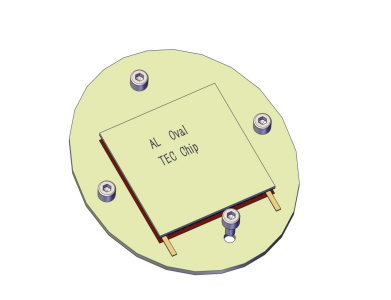
A thermoelectric cooling chip, also called a TEC or Peltier module, is a solid-state device that moves heat when DC power flows through it. Unlike traditional cooling systems with compressors or fans, it has no moving parts, relying solely on semiconductors to transfer heat between a heat source and a heatsink.
Inside the chip, p-type and n-type semiconductor blocks are electrically in series and thermally in parallel, sandwiched between ceramic plates. When powered, electrons carry heat from one side to the other—one side cools, the other heats—via the Peltier effect. Typical chips contain 50–200 semiconductor pairs working together to provide significant cooling power.
Why Compact Systems Rely on TECs
As electronics shrink, heat management becomes critical. Smartphones, medical devices, optical modules, and automotive electronics generate heat in tight spaces. Traditional methods—fans, compressors, or heat pipes—are often too bulky or orientation-dependent.
Thermoelectric cooling chips solve this problem efficiently. They are compact, solid-state, and can fit into spaces just a few millimeters thick. Their precise temperature control and small form factor make them ideal for miniaturized electronics, medical diagnostic devices, and other high-performance applications driving the TEC market today.
Five Key Advantages of the Thermoelectric Cooling Chip
Let us get specific about what makes the thermoelectric cooling chip such an attractive solution for compact systems.
1. Precision Temperature Control Within ±0.01°C
For many cooling applications, “close enough” is not good enough. Laser diodes, for instance, change wavelength with temperature—a drift of just one degree can throw off an entire optical system. Medical diagnostic equipment often requires temperature stability far beyond what mechanical thermostats can deliver. PCR (polymerase chain reaction) systems, which amplify DNA samples, rely on rapid and precise thermal cycling between multiple temperature setpoints.
A properly designed thermoelectric cooling chip can maintain temperature tolerances better than ±0.01°C. That level of precision is simply not possible with compressor-based systems, which cycle on and off and produce inevitable temperature swings. The secret lies in the fact that a TEC’s cooling power is directly proportional to the current you apply. By using a closed-loop control circuit with a thermistor or other temperature sensor, you can continuously adjust the current to maintain an exact setpoint.
When you need to hold something at precisely 25.00°C, not 25.1°C and not 24.9°C, a thermoelectric cooling chip is the tool for the job.
2. No Refrigerants, No Environmental Concerns
Traditional cooling relies on refrigerants. And most refrigerants have environmental problems. Many are potent greenhouse gases. Some damage the ozone layer. Even the newer, more environmentally friendly refrigerants require careful handling and disposal.
A thermoelectric cooling chip uses no refrigerants at all. It moves heat using electrons only. This means no leaks, no refills, no special disposal procedures, and no environmental compliance headaches. For industries that care about green credentials—and these days, that is almost everyone—this is a significant advantage.
Furthermore, because there are no refrigerants, you never have to worry about transport or storage restrictions that apply to products containing certain gases. A TEC-based product can be shipped anywhere without hazardous material declarations.
3. Silent Operation (No Moving Parts)
Moving parts make noise. Fans buzz. Compressors hum and click. Pumps vibrate. In many applications, that noise is merely annoying. But in others, it is unacceptable. Think about medical diagnostic rooms where patients are already anxious—adding a noisy cooling system does not help. Think about recording studios or broadcast equipment where background noise is the enemy. Think about residential spaces where a quiet night’s sleep matters.
A thermoelectric cooling chip generates no noise whatsoever. It has no moving parts. It does not vibrate. It does not hum. It does not click on and off. The only noise in a TEC-based system might come from a fan attached to the hot-side heatsink—but that fan is not part of the TEC itself, and in many liquid-cooling or passive-cooling configurations, you can even eliminate that fan.
4. Ultra-Compact Footprint
Size matters when you are designing for compact systems. A thermoelectric cooling chip can be as small as 3.1 mm thick and just 20 mm on a side, yet still deliver meaningful cooling power. Multistage TEC modules, which stack multiple thermoelectric layers to achieve greater temperature differentials, are still remarkably compact. New multistage designs achieve temperature differentials up to 100°C to 120°C in vacuum while maintaining ultra-compact footprints that fit into tightly constrained optical packages.
This compactness opens possibilities that would otherwise be impossible. You can place a TEC directly underneath a hot chip on a printed circuit board, cooling it locally without affecting surrounding components. You can integrate TECs into wearable devices without adding noticeable bulk. You can add active cooling to products where every millimeter of space is already allocated.
5. High Reliability with 200,000+ Hours MTBF
When you build a product, you want it to last. Customers expect it. Warranties depend on it. A compressor-based cooling system has many failure points: the compressor itself, the valves, the expansion device, and the refrigerant seals. Fans have bearings that wear out. Pumps have seals that leak.
A thermoelectric cooling chip has none of these. The accepted industry standard for TEC reliability is a minimum mean time between failures (MTBF) of 200,000 hours under steady-state operation. That is over 22 years of continuous operation. Some modules are tested to one million cycles, demonstrating exceptional stability and durability. The only potential weak point is the solder joints inside the module, but modern high-temperature solders and robust construction techniques make even that a non-issue in most applications.
A Quick Comparison: Thermoelectric Cooling Chip vs. Compressor Cooling
To help you see where the thermoelectric cooling chip fits in the cooling landscape, here is a side-by-side comparison with traditional compressor-based cooling:
| Feature | Thermoelectric Cooling Chip | Compressor-Based Cooling |
|---|---|---|
| Moving parts | None | Many (compressor, valves, expansion device) |
| Noise level | Silent (except optional fan) | Audible humming, clicking, vibration |
| Refrigerants | None | Required (often greenhouse gases) |
| Size | Ultra-compact (several mm thick) | Bulky (compressor alone is large) |
| Temperature control precision | ±0.01°C or better | Limited by on/off cycling |
| MTBF / lifespan | 200,000+ hours (solid-state) | 50,000–80,000 hours typical |
| Ability to both heat and cool | Yes (reverse polarity) | Heating requires a separate element |
| Efficiency (COP) | Lower (0.4–0.7 typical) | Higher (2.0–3.0+ typical for cooling) |
| Cooling capacity per unit size | Lower | Higher |
| Suitable for spot/local cooling | Excellent | Poor (requires full enclosure) |
| Vibration sensitivity | None (solid-state) | High (vibrations damage the compressor) |
| Cost | Low to moderate | High for small units, moderate for large |
Where does each win? Compressor cooling wins when you need to remove large amounts of heat and have plenty of space, and where efficiency is the top priority. But for compact systems, low noise, high precision, and reliability in challenging environments, the thermoelectric cooling chip is often the superior choice, especially when you consider that in heating mode, a TEC can be up to 400% more energy efficient than resistive heaters.
Real-World Applications: Where the Thermoelectric Cooling Chip Shines
Let us move from theory to practice. Here are specific applications where the thermoelectric cooling chip is already making a difference.
Consumer Electronics
Your smartphone generates heat. Its processor needs cooling, but there is almost no space inside the case. Some gaming phones and high-performance devices now use miniature thermoelectric cooling chips to keep their processors from throttling during intensive tasks. Portable refrigerators for cars and dorm rooms often use TECs instead of compressors because they are lighter, quieter, and can run off 12V DC power directly. Mobile phone radiators and handheld beverage coolers are other common examples.
Medical and Diagnostic Equipment
Medical devices demand reliability, precision, and often silent operation. Thermoelectric cooling chips are used in computed tomography scanners, cardiovascular imaging systems, MRI machines, and radiation therapy equipment. In vitro diagnostic (IVD) systems and PCR thermal cyclers rely on TECs for rapid and precise thermal cycling—some medical devices use Peltier modules to achieve the exact heating and cooling profiles required for DNA amplification.
The requirement is strict: temperature control must be accurate, repeatable, and fast. No compressor can cycle on and off quickly enough to achieve the rapid temperature ramps that PCR requires. A TEC can change temperature in less than a minute when unloaded.
Optical Communications and Laser Equipment
Optical communication modules and laser diodes are extremely sensitive to temperature. A laser’s wavelength shifts with temperature. In dense wavelength division multiplexing (DWDM) systems, where dozens of laser channels are packed into a single fiber, each laser must stay within a narrow wavelength window. Thermoelectric cooling chips provide the precise temperature stabilization that these systems demand.
New multistage TEC modules designed specifically for optical packages can achieve temperature differentials of 100°C to 120°C in vacuum while remaining small enough to fit into compact optical assemblies. These devices enable laser cooling for applications that previously required bulky, unreliable solutions.
Automotive Electronics
Modern cars are packed with electronics: advanced driver-assistance systems (ADAS), infotainment modules, LiDAR sensors, and various control units. All of these generate heat. The automotive environment is harsh—wide temperature ranges, vibration, dust, and moisture. A compressor is right out.
Thermoelectric cooling chips are increasingly used in automotive thermal management because they are solid-state (vibration-resistant), compact (fit into tight spaces), and can run off the car’s 12V or 48V electrical system directly. With the rapid growth of 5G technology and autonomous driving, cars are generating even more heat in even smaller spaces, driving further adoption of TEC solutions.
Telecommunications and Data Centers
5G base stations and edge computing nodes operate outdoors in all weather conditions, often in enclosures with limited ventilation. Thermoelectric cooling chips are being integrated into telecom equipment for precise, localized cooling of critical components such as optical transceivers and power amplifiers.
There is even research exploring whether TEC technology could become the next breakthrough in data center cooling, using semiconductors for efficient temperature control while consuming less energy than some conventional approaches. While TECs are unlikely to replace large-scale cooling systems in major data centers anytime soon, they are already finding a role in localized spot cooling for hot server components.
How to Choose the Right Thermoelectric Cooling Chip
Selecting the right thermoelectric cooling chip (TEC module) requires answering key questions:
- Target Temperature (ΔT): Determine the temperature difference needed. Single-stage TECs usually achieve 60–75°C ΔT at zero load; higher ΔT may require multistage modules.
- Cooling Power (Qc): Calculate the heat to remove, including device heat and environmental load. Add 20–30% safety margin.
- Thermal Response: TECs respond quickly due to low thermal inertia. For ultra-fast cooling, choose lower thermal mass or adjust control algorithms.
- Dimensions: TEC thickness is typically 3–5 mm, but consider the heatsink and fan. Ensure your enclosure fits the full system.
- Power Supply: Check available voltage and current. Standard modules often run on 12V or 24V DC. Use PWM controllers for optimal performance.
10 Steps to Integrate a Thermoelectric Cooling Chip for Maximum Performance
- Start with a thermal model: Use performance curves to predict ΔT under real heat loads.
- Design the hot-side heatsink first: Must dissipate both absorbed heat and electrical input.
- Use high-quality thermal interface material (TIM): Prevents air gaps that reduce cooling efficiency.
- Prevent moisture issues: Seal TEC edges for humid environments to avoid corrosion.
- Mount evenly: Apply uniform pressure to prevent ceramic cracking.
- Enable polarity reversal if needed: For heating and cooling applications.
- Place temperature sensors correctly: Measure the cooled object, not the TEC itself, for accurate feedback.
- Protect against condensation: Use desiccants, sealed enclosures, or nitrogen purging if needed.
- Include overtemperature protection: Shut down power if the hot side exceeds the maximum rating (typically 120–150°C).
- Prototype and test: Verify performance under worst-case conditions, including airflow, ambient temperature, and thermal contact quality.
FAQ
1. Can a thermoelectric cooling chip both heat and cool?
Yes. Reverse the polarity of the DC power supply, and the hot and cold sides swap. This ability to both heat and cool with a single device is unique to thermoelectric technology.
2. How long does a thermoelectric cooling chip typically last?
Industry standard MTBF is 200,000 hours minimum under steady-state operation, which exceeds 22 years of continuous use.
3. Is a thermoelectric cooling chip efficient for small cooling loads?
Yes. For compact systems with cooling requirements under about 50W, properly selected TECs can be very cost-effective and may even consume less electricity than compressor alternatives.
4. Do I need a heatsink and fan with a thermoelectric cooling chip?
Yes. The hot side must reject the absorbed heat plus the TEC’s own power consumption. Without adequate heatsinking, the hot side will overheat, and the cold side will stop cooling.
5. Can I use a thermoelectric cooling chip for outdoor applications?
Yes, but take precautions. Use sealed or coated modules to protect against moisture and corrosion, ensure the hot-side heatsink is adequate for high ambient temperatures, and add overtemperature protection.
Conclusion: The Future of Compact Cooling
The thermoelectric cooling chip offers reliable, precise, and silent cooling in ultra-compact designs. Innovations like thin-film materials and advanced multistage modules are boosting performance, efficiency, and cooling capacity.
Ideal for applications from medical devices to consumer electronics, TEC modules provide solutions where traditional cooling cannot fit or perform. Whether you need moderate or extreme cooling, a thermoelectric cooling chip delivers high-performance thermal management for your next project.