Introduction
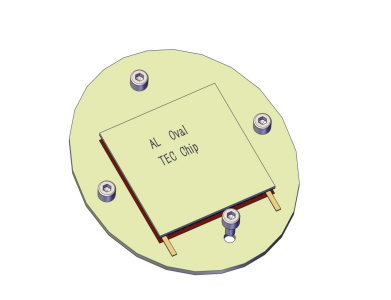
If you are designing precision electronics and struggling with thermal management, the solution is straightforward: a TEC chip—also known as a thermoelectric cooler or Peltier module. It uses the Peltier effect to transfer heat across semiconductor junctions with no moving parts, enabling temperature control accuracy down to ±0.01°C in a package smaller than a postage stamp.
This is not a theoretical concept but a proven solid-state cooling technology already used in optical transceivers, laser diodes, PCR medical instruments, and 5G base stations. The global thermoelectric cooler market was valued at approximately US$895 million in 2024 and is projected to reach US$1.58 billion by 2031 (CAGR 8.6%), driven by the increasing demand for precise thermal control in compact electronic systems. As power density continues to rise in modern electronics, passive cooling alone is no longer sufficient—TEC chips provide the active thermal control required for next-generation devices.
The Peltier Effect: The Physics Behind TEC Chips
At its core, a TEC chip is a solid-state heat pump with no compressors, no refrigerants, and no moving parts. It is built from dozens or hundreds of semiconductor pellets—typically bismuth telluride (Bi₂Te₃)—arranged electrically in series and thermally in parallel between two ceramic plates.
These pellets are alternately doped to form N-type (electron-rich) and P-type (electron-deficient) semiconductors. When a DC is applied, electrons and holes move across the junctions, carrying heat with them. At the cold side, heat is absorbed from the environment, creating cooling. At the hot side, the absorbed heat plus input electrical energy is released as waste heat. Reversing the current switches the direction, allowing the same device to provide either cooling or heating—enabling bidirectional thermal control.
The total heat rejected at the hot side equals the heat pumped from the cold side plus electrical input power. As a result, the hot side always operates at a higher temperature than the cold side, depending on load and heat sink efficiency. This makes hot-side heat dissipation critical: without proper thermal management, performance drops sharply, and device reliability is compromised.
Why do electronics engineers choose TEC over traditional cooling
If traditional cooling methods like fans or heat sinks already exist, why add a TEC chip? Because those methods have limits that TEC chips break through.
Precision control: Air cooling and passive heat sinking cannot actively pull a component below ambient temperature. A TEC chip can. When designed with a closed-loop control circuit using a thermistor or other temperature sensor, a TEC chip can maintain target temperatures with accuracy down to ±0.1°C — and in high-end laboratory implementations, even tighter. For laser diodes in optical transceivers, where a shift of even 0.5°C can change the output wavelength and knock a 5G link offline, that level of precision is non-negotiable.
Solid-state reliability: Because a TEC chip has no moving parts — no bearings to wear out, no seals to leak, no refrigerant to recharge — it offers exceptional longevity. Industry-grade TEC chips are rated for lifespans exceeding 200,000 hours of continuous operation (over 22 years) with extremely low failure rates. Some high-reliability models are tested to one million thermal cycles without degradation. For aerospace, military, and mission-critical telecom infrastructure, this level of durability is a major advantage.
Silent operation: No fans inside the module means no noise. For consumer electronics, medical diagnostic devices in quiet clinical settings, and audio equipment where fan noise would be unacceptable, a TEC chip provides cooling without acoustic penalties.
Compact form factor: A typical TEC chip measures only a few millimeters in thickness and can be manufactured in die sizes as small as a few square millimeters. This footprint allows engineers to place cooling exactly where it is needed — directly under a hot chip or within a sealed optical module — without the plumbing, ducting, or clearance requirements of liquid or forced-air systems.
The thermal management landscape: where TEC fits and where it struggles
| Cooling Method | Advantages | Limitations | Best Fit |
|---|---|---|---|
| Passive heat sink | Zero power draw, simple design | Cannot cool below ambient; limited capacity | Low-power components with natural convection |
| Forced air (fans) | High airflow, low cost | Noise, vibration, and moving parts wear | General electronics, PCs, servers |
| Liquid cooling | Very high heat flux capacity | Leak risk, complex plumbing, and pumps | High-performance computing, data centers |
| TEC chip | Active cooling below ambient, sub-0.1°C precision, solid-state | Lower COP (0.3–0.8 typical), heat buildup on the hot side | Precision optics, medical diagnostics, 5G modules |
The tradeoff is worth understanding. TEC chips typically operate at a coefficient of performance (COP) of roughly 0.3 to 0.8, significantly lower than the 1.5 to 3.0 COP typical for vapor-compression refrigeration. However, in low-power applications where total heat loads are in the tens of watts rather than thousands of watts, the absolute efficiency difference is manageable — and the benefits of precision, silence, and reliability often outweigh the energy cost.
One commonly overlooked factor is the quality of the thermal interface between the TEC chip and the heat sink. Thermal interface materials (TIMs) introduce parasitic resistance that reduces effective cooling capacity. Poor TIM application — like uneven grease coating or trapped air bubbles — can degrade performance by more than 40%, making a high-quality TEC perform like a low-grade one. This is why many failures blamed on “inefficient TEC chips” are actually failures of system integration rather than the module itself.
Where TEC chips are deployed: real applications, real performance
Optical communications and data centers. The 5G revolution depends on stable laser wavelengths. Optical transceivers (QSFP-DD, OSFP, etc.) require temperature stability because laser diodes shift wavelength with temperature — a drift of just 0.1 nm can cause signal errors and bit loss. A TEC chip mounted directly under the laser array actively holds temperature at the setpoint, compensating for ambient fluctuations and self-heating. As 5G infrastructure expands and data center optical module demand surges, this application has become the single largest driver of micro TEC market growth. A TEC chip here is not a luxury; it is an operational necessity.
Medical and life sciences. PCR thermal cyclers — the machines that amplify DNA sequences — require rapid, highly repeatable heating and cooling cycles to denature and anneal DNA strands. A TEC chip mounted in a peltier-based thermal block can cycle between precise temperatures in seconds, switching from heating to cooling by simply reversing the DC direction. Portable PCR devices and real-time diagnostic instruments increasingly rely on miniaturized TEC chips to meet shrinking form factor requirements while maintaining clinical-grade temperature accuracy.
Laser systems. From industrial laser cutters to LiDAR sensors in autonomous vehicles, laser diodes must operate within narrow temperature windows to maintain output power and prevent wavelength drift. A TEC chip mounted directly on the laser mount or submount provides localized active cooling with fast response time — typically within milliseconds of a temperature disturbance. For high-power laser bars, multi-stage TEC chips may be used, stacking multiple thermoelectric stages to achieve larger temperature differentials.
Consumer electronics and wearables. Compact refrigerators, car seat climate control systems, wine coolers, and even some high-end smartphone coolers use TEC chips to deliver localized cooling where compressor-based systems would be too bulky or noisy. As portable medical devices like insulin cooling cases gain popularity, TEC chips continue to expand into smaller, battery-powered form factors.
Design and integration: what engineers need to know
A TEC chip does not operate in isolation. Effective system integration requires careful attention to four key areas.
Hot-side heat removal. The waste heat generated at the hot side — the sum of the heat pumped from the cold side plus the electrical power consumed — must be efficiently removed. Without an adequate heat sink and fan, the hot-side temperature rises, reducing cooling capacity and potentially damaging the TEC chip. As a general rule, the hot-side heat sink should be sized to handle at least 1.5 times the electrical input power.
Drive electronics. TEC chips are current-driven devices. A dedicated TEC driver or pre-driver IC is typically required, rather than simply applying a fixed voltage. These driver ICs — available from manufacturers like Texas Instruments, Analog Devices, and others — integrate functions such as current limiting, voltage direction reversal (for heating vs. cooling), and sometimes PID control loops that read a feedback thermistor and adjust output accordingly. A well-tuned PID controller can maintain target temperatures with minimal overshoot and fast settling time, which is essential for applications like PCR cyclers where ramp rates matter.
Thermal interface quality. The surface flatness between the TEC chip, the heat source, and the heat sink must be controlled to within roughly 0.05 mm per meter. Low-quality thermal interface materials or poor application create thermal resistance that directly eats into available cooling capacity. High-performance thermal greases with thermal conductivity above 8.0 W/m·K applied in a thin, uniform layer (typically 0.08–0.12 mm thickness) are recommended.
Environmental sealing. If the cold side of a TEC chip falls below the dew point of the surrounding air, condensation will occur. In sensitive electronics, this moisture can cause short circuits or corrosion. For applications where sub-ambient cooling is required, hermetic sealing or purge gases (dry nitrogen) are often used.
Reliability metrics and industry standards
A TEC chip is a highly durable component, but not all TEC chips are created equal. When sourcing TEC modules, engineers should look for:
-
Thermal cycling tests: Premium TEC chips are tested to hundreds of thousands or even one million thermal cycles without failure. Jiangsu Jinli’s TEC chips, for example, are verified to 1,000,000 cycles, demonstrating exceptional long-term stability.
-
Material quality: High-performance TEC chips use zone-melted or hot-pressed bismuth telluride pellets with precisely controlled doping profiles. Lower-grade materials degrade faster under thermal stress.
-
Ceramic substrate selection: Alumina (Al₂O₃) is standard, while aluminum nitride (AlN) offers better thermal conductivity for higher-power applications at a higher cost.
-
Manufacturing traceability: Batch-level testing and tracking ensure consistent performance across production volumes.
FAQ
1. Can a TEC chip cool below ambient temperature?
Yes. Unlike passive heat sinks or fans, a TEC chip actively pumps heat and can achieve cold-side temperatures well below ambient. In multi-stage configurations, temperatures as low as -40°C or lower are possible depending on system design.
2. How long does a TEC chip last?
Under properly controlled operating conditions, a TEC chip can exceed 200,000 hours of continuous operation. High-reliability designs are also validated for up to 1,000,000 thermal cycles, making them suitable for long-life and mission-critical applications.
3. Does a TEC chip require a special driver?
Yes. TEC chips are current-driven devices and require a dedicated driver IC. These typically include current regulation, polarity reversal for heating/cooling modes, and PID feedback control using a temperature sensor to ensure precise thermal regulation.
4. Why does the hot side of a TEC chip get so hot?
The hot side must dissipate both the heat pumped from the cold side and the electrical input power. This combined heat load makes proper heat sink design essential. Insufficient thermal dissipation will significantly reduce performance and may damage the module.
5. Is a TEC chip energy-efficient compared to compressor cooling?
For large-scale or high heat-load systems, vapor-compression cooling is generally more efficient. However, for localized, low-power precision cooling, TEC chips offer advantages in compact size, silent operation, and high reliability that outweigh lower energy efficiency.
Conclusion: When precision matters, choose a TEC chip
A TEC chip enables a level of thermal control that traditional cooling methods cannot achieve: active, precise, and solid-state temperature regulation in an ultra-compact form factor. It is widely used in applications such as 5G optical modules, laser diode stabilization, and medical PCR systems, where temperature stability directly impacts system performance.
By combining sub-0.1°C precision control, bidirectional heating and cooling, silent operation, and long-term reliability, TEC technology has become a core solution in modern precision thermal management. While its energy efficiency is lower than that of vapor-compression systems, it is uniquely suited for applications where accuracy, size, and stability are more important than raw cooling capacity.
To explore how a TEC chip can be integrated into your thermal management system, contact our engineering team for technical datasheets, sample modules, and application-specific recommendations. We support custom configurations based on performance requirements, operating environment, and system constraints.