Introduction
As electronics, medical devices, and optical communication systems continue to shrink while power densities rise, thermal management has become one of the most critical design constraints. Conventional cooling solutions—fans, heatsinks, and compressor-based systems—are increasingly limited by size, noise, and mechanical complexity, making them difficult to integrate into compact architectures.
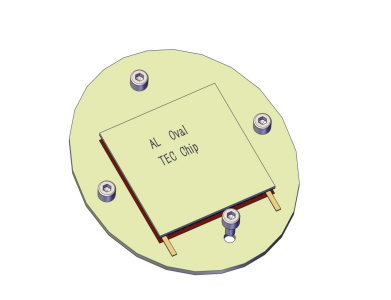
A thermoelectric cooler offers a different approach. Based on the Peltier effect, a TEC cooling chip transfers heat through solid-state semiconductor elements, eliminating the need for moving parts, refrigerants, or bulky mechanical structures. This makes it particularly attractive for space-constrained and precision-sensitive applications.
The key question for engineers is no longer what a TEC cooling chip is, but whether it can realistically compete with—or even replace—traditional cooling systems in compact device design. This article breaks down the performance, limitations, and application scenarios to support more informed engineering decisions.
What Makes a TEC Cooling Chip Different from Traditional Cooling Technologies?
-
The Solid-State Advantage
A TEC cooling chip operates on a fundamentally different principle than compressor-based or fan-based cooling systems. Traditional cooling relies on mechanical compression of refrigerants (vapor-compression) or forced convection using spinning blades. A thermoelectric cooler, by contrast, contains p-type and n-type semiconductor pellets connected electrically in series and thermally in parallel. When direct current passes through these junctions, heat is transferred from one side of the chip to the other—the cold side absorbs heat, and the hot side rejects it.
This solid-state architecture eliminates several failure-prone components. There are no compressors to seize, no refrigerants to leak, no fans to wear out, and no moving parts whatsoever. The result is a cooling solution that can operate silently for decades with minimal maintenance.
-
Size Matters: The Miniaturization Factor
Perhaps the most compelling advantage of a TEC cooling chip is its scalability. While a compressor-based system requires sufficient volume for the compressor unit, condenser coils, and refrigerant lines, a thermoelectric cooler can be manufactured in form factors as small as a few millimeters thick. This makes TEC technology uniquely suited for applications where space is at an absolute premium—think wearable health monitors, optical transceivers, and portable diagnostic instruments.
The global thermoelectric cooling module market reflects this growing demand, having surpassed the $1.06–1.2 billion mark by 2025 and continuing its strong trajectory with compound annual growth rates of 8–13% through 2030. This momentum indicates that engineers across industries are increasingly recognizing the value proposition of solid-state cooling.
How Does a TEC Cooling Chip Perform in Real-World Applications?
-
Precision Temperature Control
One of the standout features of a TEC cooling chip is its ability to achieve exceptionally precise temperature regulation. Unlike traditional cooling systems that cycle on and off, causing temperature fluctuations, a thermoelectric cooler can be finely tuned by adjusting the input current. This enables temperature stability within fractions of a degree—a critical requirement in applications like laser diode cooling, where wavelength stability depends on consistent operating temperatures.
-
Thermal Response Speed
The Peltier effect is nearly instantaneous. When power is applied, the TEC cooling chip begins transferring heat within milliseconds. This rapid thermal response is invaluable for applications requiring quick cooldown or dynamic temperature cycling, such as thermal cycling in medical diagnostics or transient cooling of high-performance CPUs.
-
Reliability Under Stress
Reliability data speaks volumes. High-quality TEC cooling chip modules undergo rigorous testing—with some models validated to one million thermal cycles. This level of durability is difficult to achieve with mechanical cooling systems, where moving parts are subject to fatigue and wear over time.
Where Are TEC Cooling Chips Making the Biggest Impact?
-
Optical Communication Modules
Fiber-optic communication systems generate significant heat in confined spaces. Transceivers, optical amplifiers, and wavelength-selective switches all require stable thermal environments to maintain signal integrity. A TEC cooling chip provides localized, precision cooling exactly where it’s needed—directly on the optoelectronic components. The compact footprint allows these chips to be integrated directly into module housings without compromising the density of board layouts.
-
Laser Equipment
Lasers are notoriously sensitive to temperature variations. Diode-pumped solid-state lasers and fiber lasers require active temperature stabilization to maintain output power and beam quality. Thermoelectric coolers have become the standard solution here, offering the combination of precision, reliability, and compactness that laser systems demand.
-
Medical Instruments
From blood analyzers to thermal cyclers used in PCR testing, medical devices often require precise, repeatable temperature control. The silent operation of a TEC cooling chip is an added benefit in clinical environments where noise pollution can affect both patient comfort and staff concentration. Moreover, the absence of refrigerants eliminates concerns about chemical exposure or environmental compliance.
-
Consumer Electronics
Smartphones, tablets, and wearable devices are pushing thermal limits as processors become more powerful and batteries denser. While passive cooling (heatsinks and heat pipes) remains the primary approach, some high-end devices are beginning to incorporate active thermoelectric cooling for targeted hot-spot mitigation. The challenge lies in power consumption—a trade-off that designers must carefully evaluate.
-
Emerging: High-Power AI Chips
Recent research has explored integrating thermoelectric coolers with loop heat pipes for cooling high-power AI chips in harsh environments. The hybrid approach leverages the TEC’s active heat-pumping capability to enhance passive cooling systems, achieving performance that neither technology could deliver alone. This suggests that TEC technology is not necessarily replacing traditional cooling but augmenting it in sophisticated thermal management architectures.
TEC Cooling Chip vs. Traditional Cooling: A Side-by-Side Comparison
| Feature | TEC Cooling Chip | Compressor-Based Cooling | Fan + Heatsink Cooling |
|---|---|---|---|
| Moving parts | None | Many (compressors, valves) | One (fan motor) |
| Noise level | Silent | Moderate to loud | Audible |
| Size scalability | Excellent (sub-mm possible) | Poor (minimum volume required) | Moderate |
| Temperature precision | ±0.01°C achievable | ±1–2°C typical | Poor (ambient-dependent) |
| Cooling capacity per volume | Moderate | High | Low to moderate |
| Maintenance | None | Regular (refrigerant, oil) | Occasional (cleaning, replacement) |
| Environmental impact | No refrigerants | CFC/HFC concerns | None |
| Energy efficiency (COP) | 0.5–1.2 typical | 2.0–4.0 typical | N/A (not active cooling) |
| Response time | Milliseconds | Seconds to minutes | Seconds |
| Best application | Precision, compact, low-to-moderate heat loads | High heat loads, large spaces | Low heat loads, cost-sensitive |
*Note: COP (Coefficient of Performance) values vary significantly based on operating conditions. Research has demonstrated TEC systems achieving COP values of 1.2 under optimized conditions, while vapor-compression systems typically achieve higher COP but sacrifice size and precision.*
What Are the Limitations of TEC Cooling Chips?
-
Energy Efficiency Considerations
It would be disingenuous to claim that a TEC cooling chip outperforms compressor-based systems in every metric. The coefficient of performance—the ratio of cooling output to electrical input—is generally lower for thermoelectric coolers than for vapor-compression systems. This means that for a given cooling load, a TEC will consume more electricity than a compressor-based system of comparable capacity.
However, this comparison requires context. In small-scale applications where compressor-based systems cannot physically fit, the efficiency comparison is moot—there is no alternative. Moreover, as thermoelectric materials continue to improve, the efficiency gap is narrowing. Recent innovations have demonstrated a 33% enhancement in COP through novel integration designs.
-
Heat Rejection Requirements
A TEC cooling chip does not eliminate heat; it moves it from the cold side to the hot side. The hot side must be equipped with adequate heat rejection—typically a heatsink and fan—to dissipate the combined heat load (the heat pumped from the cold side plus the electrical power consumed). In compact devices, managing this hot-side rejection can be as challenging as the cooling task itself.
-
Cost Factors
High-quality thermoelectric materials, particularly bismuth telluride-based compounds, are more expensive than the copper and aluminum used in traditional heatsinks. This cost differential can be significant for high-volume consumer products. However, for specialized applications in medical, optical, and aerospace sectors where performance justifies the expense, TEC technology remains highly cost-effective.
Can a TEC Cooling Chip Replace Traditional Systems Entirely?
The short answer is: it depends on the application. Let’s break this down by scenario.
When a TEC Cooling Chip Is the Clear Winner
For applications requiring sub-ambient cooling in confined spaces, the TEC cooling chip has no practical competitor. Optical modules, laser diodes, and miniature medical sensors simply cannot accommodate compressor-based systems. In these cases, the question isn’t whether TEC can replace traditional cooling—it’s whether any cooling solution other than TEC is even feasible.
For applications prioritizing silent operation, thermoelectric coolers are unmatched. Hospital equipment, studio-grade audio electronics, and laboratory instruments all benefit from the absence of fan noise and compressor hum.
For applications demanding extreme precision, the fine-grained controllability of a TEC cooling chip sets it apart. When temperature stability of ±0.01°C is required, no mechanical system can compete.
When Traditional Cooling Still Holds the Edge
For applications with high heat loads (hundreds of watts or more) and ample space, compressor-based systems remain more energy-efficient and cost-effective. Data centers, commercial refrigeration, and industrial process cooling are unlikely to adopt TEC technology as a primary cooling method in the near future.
For cost-sensitive consumer products where a few degrees of temperature rise are acceptable, passive cooling (heatsinks alone) or simple fan-based solutions may be sufficient and cheaper than adding a TEC.
The Hybrid Approach: The Best of Both Worlds
Increasingly, engineers are exploring hybrid thermal management architectures that combine the strengths of multiple technologies. A TEC cooling chip can be integrated with heat pipes, vapor chambers, or even liquid cooling loops to achieve performance that neither technology could deliver alone. In this model, the TEC provides targeted, localized cooling for hot spots while the passive or active system handles bulk heat rejection.
This trend suggests that the framing of “replacement” may be outdated. The more relevant question is: how can a TEC cooling chip be optimally integrated into a thermal management strategy?
What Should Engineers Consider When Specifying a TEC Cooling Chip?
Thermal Load Calculation
The first step is quantifying the heat that needs to be removed. This includes both the device’s power dissipation and any environmental heat gain. Over-specifying leads to unnecessary cost and power consumption; under-specifying results in inadequate cooling and potential device failure.
Operating Temperature Range
A TEC cooling chip can achieve a temperature differential (ΔT) between its cold and hot sides. The maximum ΔT depends on the number of stages (single-stage vs. multi-stage) and the thermoelectric materials used. Multi-stage TECs can achieve cryogenic temperatures down to 200K for specialized applications.
Power Budget
The electrical power consumed by a TEC cooling chip must be factored into the device’s overall power budget. In battery-powered portable electronics, this is a critical constraint. However, recent advances in flexible thermoelectric coolers are addressing power consumption challenges for wearable applications.
Environmental Conditions
Ambient temperature, airflow, and available space for heat rejection all affect TEC performance. The hot side must be kept sufficiently cool to maintain the desired temperature differential. In harsh environments, additional measures such as loop heat pipes may be necessary.
Reliability Requirements
For applications requiring long service life with zero maintenance—such as telecommunications infrastructure or space-borne instruments—the solid-state reliability of a TEC cooling chip is a decisive advantage.
The Future of TEC Cooling Technology
-
Material Innovations
The thermoelectric figure of merit (ZT) determines how efficiently a material converts electricity into a temperature difference. Researchers are actively developing new materials—including magnesium-based compounds and flexible thermoelectrics—that promise higher ZT values and lower costs. These advances will improve both the efficiency and affordability of TEC cooling chip technology.
-
Integration with Emerging Technologies
As AI chips, 5G infrastructure, and autonomous vehicles generate unprecedented thermal challenges, thermoelectric cooling is being evaluated as part of comprehensive thermal management solutions. The ability to provide localized, on-demand cooling precisely where it’s needed aligns perfectly with the trend toward heterogeneous integration and chiplet architectures.
-
Sustainability Imperatives
With growing regulatory pressure to phase out hydrofluorocarbon refrigerants, solid-state cooling technologies are gaining attention as environmentally friendly alternatives. A TEC cooling chip contains no greenhouse gases, no ozone-depleting substances, and requires no special handling at end-of-life.
Conclusion
Can a TEC cooling chip replace traditional cooling systems in compact devices? The answer is nuanced. In micro-spaces requiring sub-degree precision and absolute reliability, the TEC cooling chip excels where bulky, traditional systems fail. While large-scale cooling still has its place, the shift toward compact, high-efficiency layouts makes solid-state technology foundational for next-generation hardware.
For engineers balancing tight thermal budgets in optical transceivers, medical diagnostics, or laser diodes, a high-performance TEC chip offers the exact predictability your design needs.
Ready to validate these thermal performance metrics in your own lab? Contact SGETTEC today to exchange technical requirements, review performance curves, or request a qualified sample for testing.