Introducción
A low-cost TEC chip may seem like a smart procurement choice. The price fits the budget, the specifications appear acceptable, and delivery requirements are met. However, the hidden costs often emerge after deployment.
Over time, unstable temperature control, reduced cooling performance, unexpected failures, and maintenance expenses can quickly eliminate the initial savings. In industrial applications, the cheapest Chip TEC is rarely the most cost-effective solution. Reliability, performance, and lifecycle value matter far more than the upfront price.
What Makes a TEC Chip Suitable for Industrial Use?
Industrial environments are far more demanding than consumer applications. Factory equipment must operate under continuous workloads, temperature fluctuations, vibration, dust, and humidity. A TEC chip that performs well in a laboratory setting may not deliver reliable performance when integrated into industrial equipment such as machining systems, laser devices, or automated production lines.
For industrial-grade TEC chips, cooling capacity and coefficient of performance are only part of the evaluation. Long-term reliability also depends on thermal cycling resistance, mechanical strength, solder joint durability, material consistency, and manufacturing precision. High-quality thermoelectric modules achieve stable performance through controlled material properties, precise production processes, and rigorous reliability testing.
Choosing a TEC chip for industrial use means investing in long-term system stability, not just purchasing a component. The initial unit price is only one part of the equation—the true value is determined by reliability, maintenance requirements, and total lifecycle cost.
The hidden costs of a low-cost TEC chip in factory automation
Let us walk through a typical industrial scenario. A packaging machine uses multiple TEC chips to maintain a precise temperature on sealing bars. The system runs three shifts, five days a week. Ambient temperature fluctuates between 10°C and 45°C. The TEC chips cycle on and off with each sealing operation.
A cheap TEC chip might cost $12 instead of $35. But its internal solder joints are made with a lower-grade Sn-Sb alloy instead of Au-Sn. After 5,000 thermal cycles—about three months of operation—microcracks appear. Electrical resistance creeps up. Cooling capacity drops by 15%. The sealing bars no longer reach the setpoint temperature consistently. Product seals fail quality inspection. The line supervisor calls maintenance. Maintenance replaces the module, but the new one is from the same cheap batch. The cycle repeats.
Now tally the costs:
-
Replacement TEC chip: $12 (again)
-
Maintenance labor (2 hours at $80/hour): $160
-
Production downtime (45 minutes at $500/hour lost output): $375
-
Scrapped product from the failed seals: $200
-
Quality inspection rework: $150
That one failure cost nearly $900. A premium industrial TEC chip at $35, with proper solder materials and tighter tolerances, would have lasted 50,000 cycles or more. The math is not even close.
Beyond direct costs, there is the hidden tax on engineering resources. Your design team spends weeks investigating intermittent temperature drift, only to discover it is a batch-to-batch variation in thermoelectric material purity. Your procurement team spends hours negotiating replacements and expediting shipments. Your quality team writes exception reports. None of this appears on the original purchase requisition, but all of it hits your operating budget.
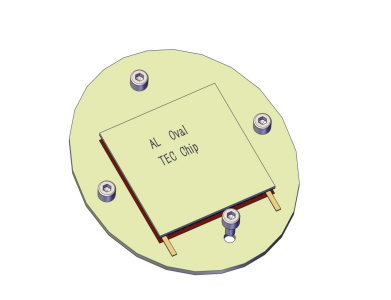
How Does Material Quality Affect TEC Chip Reliability in Harsh Environments?
The performance and reliability of a TEC chip depend heavily on the quality and consistency of its thermoelectric materials. The semiconductor pellets inside a TEC chip are typically made from bismuth telluride (Bi₂Te₃), often combined with elements such as antimony or selenium to optimize thermoelectric performance. While the figure of merit (ZT) is an important indicator of cooling efficiency, industrial applications also require excellent material consistency, stability, and durability.
High-quality manufacturers carefully control dopant concentration, crystal structure, and material processing to achieve consistent thermoelectric properties across each module. Advanced manufacturing methods, such as controlled sintering, hot pressing, and precision material processing, help reduce variations in parameters such as Seebeck coefficient and electrical resistance. For industrial systems that require precise temperature control, even small performance variations between TEC chips can affect overall system stability.
This is especially critical in applications such as semiconductor manufacturing, where processes like photolithography require extremely stable temperature conditions. A TEC chip with inconsistent thermal performance may struggle to maintain precise control, potentially affecting process repeatability and product quality. As a result, manufacturers often choose industrial-grade TEC chips with verified material properties and reliability data rather than focusing only on the initial purchase price.
Material quality also plays a major role in thermal cycling reliability. During repeated heating and cooling cycles, ceramic substrates and semiconductor pellets expand and contract at different rates, placing stress on solder joints and internal structures. Reliable TEC chips use optimized materials, durable solder technologies, and precise assembly processes to better withstand these mechanical stresses. In demanding industrial environments, superior material quality helps maintain cooling performance and extend service life under continuous operation.
The procurement dilemma: cheap TEC chip vs. total cost of ownership
Procurement professionals are measured on cost savings. But the smartest procurement organizations measure total cost of ownership (TCO), not invoice price. For a TEC chip in an industrial application, TCO includes:
-
Initial unit cost
-
Incoming inspection and qualification testing
-
Assembly and mounting labor
-
Field failure rate and replacement frequency
-
Production downtime per failure
-
Warranty claims and customer compensation
-
Engineering troubleshooting hours
-
Spare parts inventory carrying cost
A TCO analysis from a 2023 industry survey of thermal management buyers found that the average industrial user spends 3.6 times the purchase price of a cheap TEC chip on failure-related costs within the first two years. For high-reliability applications like medical imaging or aerospace, that multiplier exceeds 10×.
Let us compare two typical offerings side by side:
| Metric | Economy TEC Chip | Industrial-Grade TEC Chip |
|---|---|---|
| Unit price | $10–$15 | $30–$50 |
| Solder material | Sn-Sb (low-cost) | Au-Sn or high-ductility alloy |
| Ceramic substrate | Alumina (standard) | Alumina or AlN with flatness ≤0.02mm |
| Thermal cycling life (ΔT=100°C) | 8,000–12,000 cycles | 40,000–60,000 cycles |
| MTBF (steady-state) | 80,000 hours | >200,000 hours |
| Batch-to-batch variation | ±20% in resistance | ±5% in resistance |
| Field failure rate (2 years) | 12–18% | <2% |
| Typical TCO per unit (over 3 years) | $180–$300 | $80–$120 |
The industrial-grade TEC chip costs three times as much upfront. It delivers five times the thermal cycling life and one-tenth the failure rate. Over three years, it saves you $100–$180 per installed unit. For a system with 100 TEC chips, that is $10,000–$18,000 in direct savings—not counting the avoided headaches.
Industrial-grade TEC chip specifications you should not overlook
When evaluating TEC chip suppliers for industrial applications, push beyond the basic cooling capacity and voltage specs. Ask for these critical parameters:
AC resistance and its stability. AC resistance is a sensitive indicator of solder joint health. A gradual rise in AC resistance over time signals impending failure. High-quality suppliers provide AC resistance limits and test each chip at multiple temperatures.
Thermal cycle test data. Request the Weibull plot showing failure distribution after repeated temperature cycles. A reputable supplier will share this data. If they cannot provide it, treat that as a red flag.
Height tolerance and parallelism. For multi-module arrays, height variation must be ≤±0.03mm. Loose tolerances cause uneven clamping, which leads to mechanical stress and premature fracture.
Ceramic flatness. Warped ceramics prevent proper thermal interface contact, increasing thermal resistance and reducing cooling performance. Industrial-grade modules specify flatness to within 0.02mm per 25mm length.
Thermal time constant. This parameter affects temperature control responsiveness. Fast-responding TEC chips are critical for applications like laser diode stabilization or rapid thermal cycling.
Operating temperature range. Industrial environments often exceed the standard -40°C to +85°C. Some applications require hot-side temperatures up to 150°C. Make sure the TEC chip is rated for your actual extremes.
Vibration and shock ratings. Factory floors, vehicles, and aerospace platforms subject TEC chips to continuous vibration. MIL-STD-883 and similar standards define acceptable test conditions. Always verify that the module has passed relevant mechanical tests.
A cheap TEC chip supplier will typically omit these details or provide only nominal values. An industrial-focused supplier will offer comprehensive qualification reports, application notes, and engineering support to help you integrate the module correctly.
Real-world industrial scenarios where cheap TEC chips fail most often
Let us examine three common industrial use cases to see how cost-cutting backfires.
Case 1: Laser marking systems. These systems require precise temperature control of the laser diode to maintain beam quality and power stability. A low-cost TEC chip with poor thermal cycling endurance begins to drift after a few thousand hours. The laser output power fluctuates, causing inconsistent marking depth on metal parts. The production line rejects 5% of the output. The scrap cost alone exceeds the savings from the cheap TEC chips by a factor of 20.
Case 2: Battery thermal management in electric vehicles. EV battery packs use TEC chips in some thermal regulation designs. The modules experience both high ambient heat from the drivetrain and cold starts in winter. Cheap TEC chips with brittle solders crack under this thermal shock. A failed module means uneven cell temperatures, reduced battery life, and potential safety risks. Automakers have learned this lesson the hard way—that is why Tier 1 suppliers only use AEC-Q-certified thermoelectric coolers.
Case 3: Process chillers for plastic injection molding. These chillers maintain mould temperature within tight bands to ensure part dimensional accuracy. A cheap TEC chip that loses cooling capacity forces the chiller compressor to run longer, increasing energy consumption. The extra electricity cost over a year can exceed the price difference between cheap and premium TEC chips many times over. Additionally, the frequent module replacements require scheduled downtime, which eats into production capacity.
These examples are not hypothetical. Industry forums and reliability engineering papers are filled with case studies of cost-driven component choices that led to expensive field failures. The consensus is clear: in industrial environments, the reliability of a TEC chip directly impacts operational profitability.
Why a reliable TEC chip supplier matters more than a low price
When you buy a TEC chip, you are also buying the supplier’s process control, quality culture, and engineering knowledge. A low-price vendor often operates with minimal quality assurance—they may not perform 100% testing, they may outsource material preparation, and they may have limited failure analysis capabilities.
In contrast, a reputable industrial TEC chip manufacturer invests in:
-
In-house semiconductor processing for consistent material properties
-
Automated assembly lines with real-time process monitoring
-
100% electrical and thermal parameter testing on every module
-
Environmental stress screening to weed out early failures
-
Comprehensive application engineering support
These investments cost money, but they reduce your risk. When your TEC chip supplier can provide detailed reliability data, failure-mode analysis, and mounting recommendations, you are far less likely to encounter unexpected failures. Moreover, a good supplier will work with you to select the right grade of TEC chip—perhaps a standard industrial module, or if your demands are extreme, a military-grade or custom design.
The B2B procurement decision should never be made solely on unit price. Request a supplier audit. Visit their manufacturing facility if possible. Review their quality certifications (ISO 9001, IATF 16949, or AS9100 for aerospace). Ask for references from other industrial customers. The time spent qualifying a supplier upfront is far less than the time spent managing failures later.
The long-term view: investing in quality pays off
Industrial equipment is expected to last ten, fifteen, or even twenty years. A TEC chip that fails after two years forces an unplanned maintenance event. If that component is embedded deep inside a machine, the replacement cost can be orders of magnitude higher than the component itself—disassembly, recalibration, and requalification add significant labor and downtime.
Furthermore, modern industrial systems are increasingly connected and data-driven. Sensors may detect a temperature drift caused by a degraded TEC chip, but the alert often comes during production, not during scheduled maintenance. That means emergency response, expedited shipping, and overtime labor—all at premium rates. These costs are rarely included in the initial ROI calculation, but they are very real.
A study on industrial electronics reliability estimated that unplanned downtime costs an average of $5,000 per minute in high-value manufacturing sectors like automotive and semiconductors. If a cheap TEC chip causes just 10 minutes of downtime per year, that is $50,000 lost. Compare that to the few extra dollars per module for a reliable industrial-grade TEC chip—the decision becomes obvious.
How to select the right TEC chip for your industrial project
To avoid the hidden costs of cheap TEC chips, adopt a systematic selection process:
-
Define your application profile. Document the operating temperature range, cycling frequency, vibration levels, and required lifetime. Be realistic about worst-case conditions.
-
Translate requirements into specifications. Map your profile to TEC chip parameters: maximum current, voltage, cooling power, thermal resistance, and mechanical dimensions. Include reliability requirements like minimum thermal cycles and MTBF.
-
Shortlist suppliers based on quality, not price. Look for suppliers with proven industrial experience, relevant certifications, and transparent testing data. Price is a secondary consideration.
-
Request samples and run your own qualification. Test the TEC chips under your actual operating conditions, including thermal cycling and vibration, for at least a few hundred cycles. Measure key parameters before and after.
-
Evaluate the total cost of ownership. Use a spreadsheet to estimate TCO over your expected product life. Include all direct and indirect costs. Compare at least three supplier options.
-
Build a partnership. Once you select a supplier, maintain open communication about your future needs and any field performance feedback. A good supplier will use that feedback to improve their products and support.
This process takes effort upfront, but it pays for itself many times over through fewer field failures, lower maintenance costs, and higher customer satisfaction.
Conclusión
In industrial applications, a TEC chip is more than a standard component—it is a critical part of the thermal management system. Its reliability directly affects equipment performance, production stability, product quality, and long-term operating costs.
Although a low-cost TEC chip may reduce initial investment, the potential costs associated with performance degradation, unexpected failures, maintenance, and downtime can quickly outweigh the upfront savings. Industrial-grade TEC solutions with consistent materials, precise manufacturing, and reliable testing help reduce lifecycle costs and improve system reliability.
Before selecting a TEC chip supplier, consider more than the purchase price. Evaluate material quality, manufacturing capabilities, reliability data, and technical support to ensure the selected solution meets your application requirements.
Need Help Choosing the Right TEC Chip for Your Industrial Application?
Our thermal engineering team provides industrial-grade thermoelectric cooling solutions, reliability data, and application support to help customers select the right TEC chip for their systems. Contact us to discuss your specifications and explore a reliable thermal management solution designed for long-term performance.