Abstract:
TEC Chip thermal technology has experienced significant development over the past decades. The TEC Chip (thermoelectric cooler chip) has become a fundamental component in the thermal management of electronics, medical instruments, laser systems, and portable refrigeration.
According to Rowe’s Handbook of Thermoelectrics (CRC Press), modules that operate based on the Peltier effect are said to have a thermoelectric effect, which enables the transfer of solid-state heat without the need for moving parts, refrigerants, or compressors. Other technical studies in Applied Physics Letters and IEEE journals have demonstrated that the increased technical proficiency in Bi₂Te₃ materials, micro-sized semiconductor junctions, and optimized heat sink design has increased the efficiency and reliability of TECs.
This article combines materials science, thermal engineering calculations, practical application examples, efficiency analysis, system integration rules, and troubleshooting methods, all of which contribute to a greater understanding of practical applications, design, and technical decisions.
Introduction: Why TEC Chips Matter in 2026?
As electronics have continued to diminish while power densities have increased, the effective management of thermal energy has become a critical design problem. High-powered CPUs, laser pointers, medical imaging devices, automotive LiDAR systems, battery components, and laboratory equipment all require precise temperature control in order to maintain the stability of performance and lifespan. The TEC Chip has become a popular choice in situations that require compactness, lack of vibrations, and precise temperature control.
Unlike traditional compressor-based cooling systems, TEC Chips are silent, contain no refrigerants, and have bidirectional temperature control ( cooling or heating). This dual functionality enables them to be essential in environments with precise control, including DNA amplifiers, infrared sensors, and communication modules for fiber optics.
In 2026, enhancements to semiconductor materials, multiple stages of TEC design, and advanced thermal interface materials (TIMs) will further expand the number of possible applications. This guide discusses the proper way to utilize a TEC Chip to maximize efficiency and have a long lifespan.
What Is a TEC Chip? Technical Definition and Core Structure
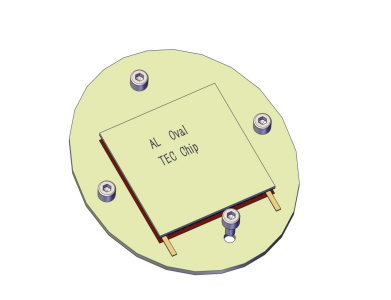
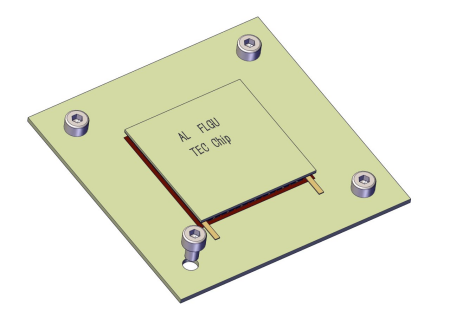
A TEC chip (thermoelectric cooler chip) is a solid-state device that contains multiple pairs of p- and n-type semiconductors that are connected to each other by electricity and are also thermally connected in series. When direct current traverses the junctions, heat is taken up on one side (the cold side) and released on the other side (the hot side); this is called the Peltier effect.
A common TEC module has:
- Substrates for ceramic plates (typically aluminum oxide)
- P-type and N-type bismuth telluride semiconductor chips
- Copper wire traces
- Glue-based joints
- Encapsulation to strengthen the mechanical properties
The lack of mechanical components greatly diminishes the vibrations, noise, and maintenance needed. However, the performance of the system is primarily dependent on the external design of heat dissipation.
Working Principle of a TEC Chip
The TEC Chip’s function is via three thermal-related phenomena:
- Peltier Effect – The primary mechanism for cooling.
- Seebeck Effect – associated with the generation of voltage from a temperature difference.
- Joule Heating – The resistive heat generated by electrical power.
- When the DC voltage traverses the semiconductor boundaries,
Electrons travel through the thermal energy-rich side of the spectrum to the energy-poor side.
Heat is transferred to the environment by convection.
The external heat sink is responsible for removing the heat that has accumulated on the hot side.
The net cooling capacity depends on:
- Applied current (I)
- Voltage (V)
- Temperature difference (ΔT)
- Internal electrical resistance (R)
- Thermal conductance (K)
The fundamental cooling equation is:
Q_c = αIT_c − ½I²R − KΔT
Where:
- Q_c = cooling capacity
- α = Seebeck coefficient
- T_c = cold side temperature
Understanding this relationship is critical when selecting a TEC Chip for industrial applications.
Types of TEC Chips in 2026
The TEC market has diversified significantly. Engineers must select the appropriate module based on thermal load and operating conditions.
| Type | Description | 일반적인 응용 분야 | ΔT Range |
| Single-Stage TEC | Standard cooling module | Electronics cooling | Up to 70°C |
| Multi-Stage TEC | Stacked cooling elements | Scientific instruments | Up to 120°C |
| Micro TEC Chip | Miniaturized version | Wearables, sensors | Moderate |
| High-Power TEC | Large module, high current | Battery packs, industrial lasers | Moderate to High |
Single-stage TEC Chips remain the most common, while multi-stage modules are used for extreme temperature differentials.
Key Selection Criteria for TEC Chip
Selecting the appropriate TEC chip is more than just a matter of size and cost.
- Cooling capacity (Qmax)
This indicates the maximum capacity for heat pumping that occurs at zero temperature difference. It must be greater than the thermal load of the system.
- The maximum temperature difference (ΔTmax)
Indicates the maximum temperature difference that can be achieved between the hot and cold sides.
- Operating at Current and Voltage
The electrical compatibility of power supplies is crucial to the design of the power supplies.
- Module Dimensions
Compact devices have a precise requirement for exact footprint placement.
- Robustness and Life Cycle
High-quality solder joints and resilient ceramic materials increase the lifespan.
TEC Chip Performance Comparison Table
| 파라미터 | Entry-Level TEC | Industrial-Grade TEC | Scientific Multi-Stage |
| Qmax | 20–40W | 60–150W | 10–50W |
| ΔTmax | 60°C | 70°C | 100–120°C |
| Efficiency | Moderate | High | Lower (due to staging) |
| Lifespan | 20,000 hrs | 50,000+ hrs | 30,000 hrs |
| Cost | Low | Medium | High |
Industrial-grade modules offer an optimal balance between power and durability.
How to Properly Install a TEC Chip?
The correct installation of the product has a significant impact on the performance and longevity of the product.
Initially, spread out uniform amounts of thermal interface material (TIM) over the contact surfaces. Uneven pressure can cause ceramic plates to break.
Second, attach the TEC Chip to the heat sink and the cold plate using a controller that controls the torque.
Third, make sure the hot side of the chipset is able to dissipate the excess heat. A badly conceived heat sink will lead to thermal overrun.
Fourth, utilize temperature sensors to provide feedback.
Finally, test systems that are incremental in their current levels to avoid overdriving.
Heat Sink and Thermal Management Considerations
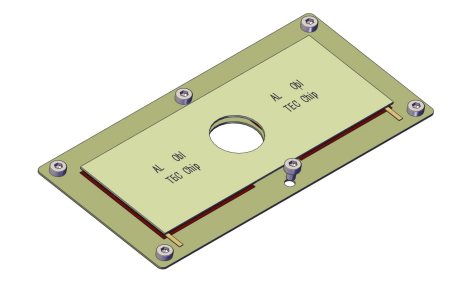
TEC Chips can’t eliminate heat; instead, they take it in and transfer it to the surroundings. The warm side must escape:
Total heat = the total amount of heat that is pumped + the electrical power that is input.
Inappropriate heat sinking is the most common cause of TEC failure. Complex and advanced systems include:
- Plates that cool down by liquid action
- Heat pipes
- Air-force aluminum foil arrays
- Integrating the vapor chamber
The calculations of thermal resistance should always be preceded by a system integration.
Applications of TEC Chips in 2026
TEC Chips are widely used across industries:
- Electronics
Cooling devices, such as CPUs, GPUs, and FPGAs, that require a consistent temperature.
- Medical Supplies
PCR machines and laboratory heat generators need to have a rapid temperature swing.
- Optical Systems
Laser diodes and infrared sensors require precise temperature regulation.
- Automotive
ADAS cameras and LiDAR chips need to be compacted.
- Consumer Products
Portable refrigerators and temperature-regulated storage containers.
Advantages and Limitations of TEC Chips
Advantages:
- No moving parts
- Opération sans bruits
- Temperature regulation specific to this process
- Small size
- Bidirectional temperature control
Limitations:
- Lower efficiency regarding energy consumption compared to air conditioning systems.
- Heat sink dependence
- Small-scale ability to refrigerate in large quantities.
- Understanding trade-offs facilitates the most effective implementation.
Common Mistakes When Using TEC Chips
Many system failures stem from design errors:
- Oversizing current beyond rated limits
- Ignoring thermal resistance calculations
- Using poor-quality thermal paste
- Inadequate airflow
- No temperature control feedback loop
Professional design simulation software is recommended before deployment.
Efficiency Optimization Strategies
To improve TEC Chip performance:
- Operate below maximum current for higher COP
- Improve hot-side cooling
- Minimize thermal resistance
- Use PWM control carefully
- Integrate PID temperature control algorithms
- Balanced electrical and thermal design ensures stability.
Maintenance and Reliability Considerations
While TEC Chips require minimal maintenance, periodic inspection of:
- Heat sink cleanliness
- Electrical connections
- Thermal paste degradation
- Mechanical mounting pressure
is recommended for long-term reliability.
Frequently Asked Questions (FAQ)
Q1: What is the function of a TECChip?
A TEC chip has the ability to transfer heat from one surface to another via the Peltier effect, which enables the use of solid-state cooling or heating.
Q2: Is a TEC Chip more effective at reducing the temperature of a computer?
Typically no. Compressor systems are more effective at reducing the energy expenditure of large-scale cooling, but TEC Chips provide both precision and compactness.
Q3: Is it possible to overheat a TEC Chip?
Yes, if the hot side is not sufficiently cooled, the internal temperature can increase and adversely affect the module.
Q4: How long does a TEC Chip have?
High-quality industrial components can have a lifespan of over 50,000 hours if they are properly cared for.
Q5: What industries have the greatest use of TEC Chips?
Electronics, medical devices, optical systems, and the automotive industries.
Future Trends of TEC Chip Technology
In the long run, innovations will focus on the following:
More advanced Thermoelectric materials with higher ZT.
Small-scale semiconductors
Enhancement of the module’s compactness
Integrated temperature control chips that are smart
Cooling systems that are hybridized with vapor compression and TEC.
The revelation of material science’s secrets may greatly increase the efficiency of products.
결론
The TEC Chip continues to be a significant part of modern thermal management. While not intended to replace traditional refrigeration systems in large installations, it provides a precise, compact design and dependability for electronics, instruments, and high-tech devices.
The proper choice, installation, and design of the heat sink, and the management of the current are all critical to achieving the greatest performance. By comprehending the principles of physics, the engineering parameters, and the integration strategies listed in the 2026 TEC Chip Use Guide, professionals in the engineering and consumer goods industries can utilize TEC solutions with ease and confidence.
As the demand for compact, silent, and precise cooling continues to increase, TEC Chips will still be important to the next generation of product development.