Article Summary:
A TEC chip is a chip that switches heat from one side to the other when electricity runs through it. This phenomenon is derived from the Peltier effect, which was first documented in the 19th century and was later formalized in modern thermoelectric theory.
The CRC Handbook of Thermoelctrics, as well as other peer-reviewed publications in Applied Physics Letters and Journal of Electronic Materials, reports that TEC chips are popular in the electronics industry, medical technology, optical systems, automotive electronics, aerospace instruments, and precision machinery.
This article provides a comprehensive, industry-grade explanation of how a TEC Chip works, covering physical principles, internal structure, working process, performance parameters, advantages, limitations, applications, and future trends.
Introduction: Why TEC Chips Matter in Modern Industry
Today, thermal management is one of the most significant problems in modern engineering. As electronic components become smaller, more powerful, and more densely packed, traditional methods of cooling like fans and liquid reservoirs have been increasing in limitations. This is the location of the TEC Chip’s distinguished attributes as a small, silent, and highly controllable cooling system.
TEC chips are different from mechanical refrigeration systems, which have no moving parts and operate without noise, they also allow for precise temperature control by adjusting electrical power. These attributes make them essential in applications that require reliability, hygienic behavior, and precise temperature regulation.
Understanding the functioning of a TEC chip is therefore not only pertinent to engineers and designers; it is also important to technical decision makers in multiple disciplines, including procurement, product development, and technical feasibility.
What Is a TEC Chip?
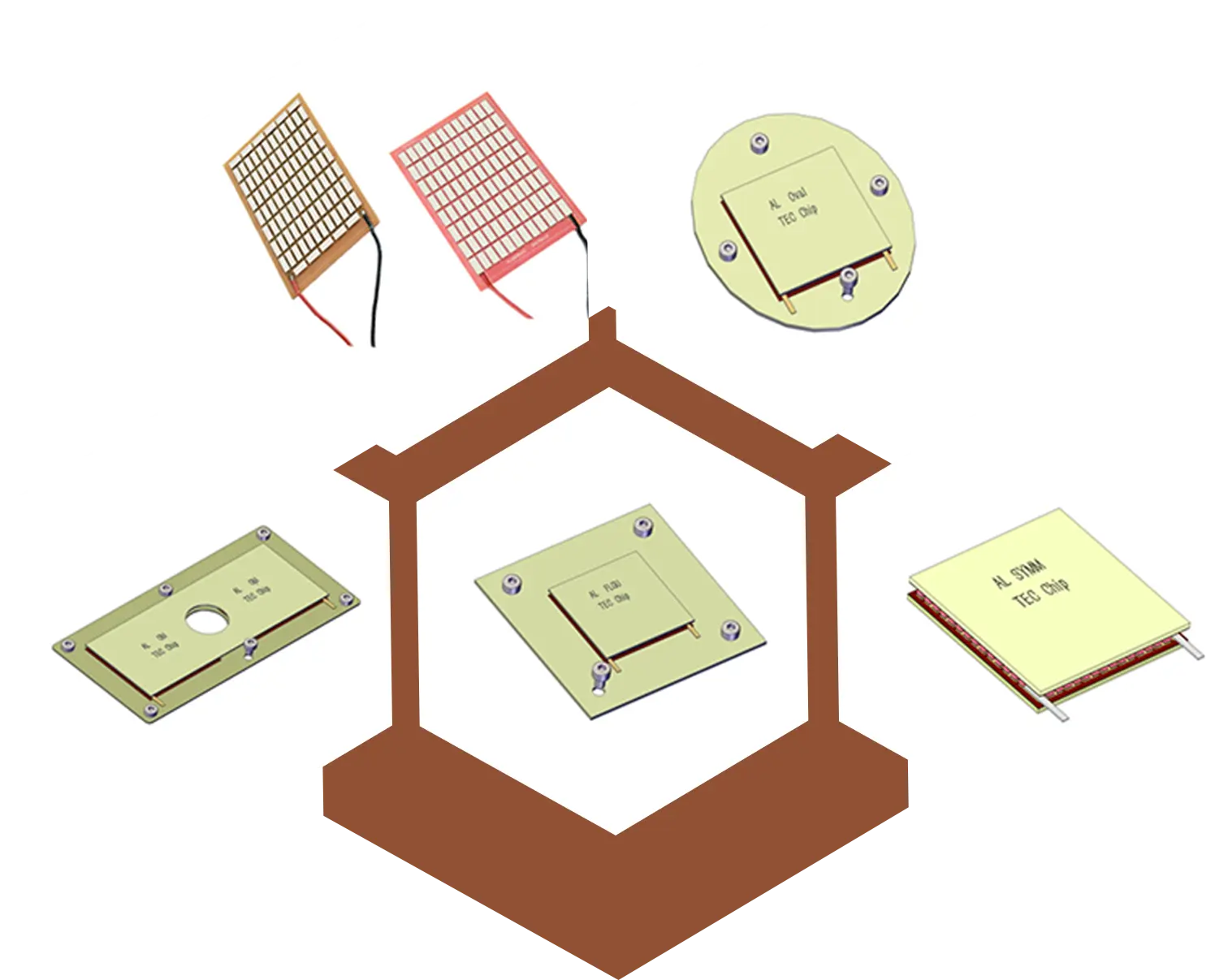
A TEC Chip (also known as a Peltier module) is a semiconductor device that utilizes electricity to create a temperature difference between its two surfaces.
In concrete terms:
One aspect of the TEC chip is frozen
The other side becomes cold
Heat is transferred from the cold side to the hot side by active means.
This heat-pumping mechanism is devoid of compressors, refrigerants, or mechanical motion; it is specific to TEC chips, as opposed to conventional cooling methods.
The Scientific Principle Behind a TEC Chip
The Peltier Effect
The operation of a TEC chip is based on the Peltier effect, which was discovered by Jean Charles Athanase Peltier in 1834. The effect describes the way in which heat is absorbed or released at the meeting point of two different conductive substances when an electric current is passed through them.
On a TEC chip,
When electricity runs in one direction, heat is taken up at one point (refilling).
Heat is released at the other meeting point (heating)
Reversing the current flow direction switches the hot and cold ends.
This bidirectional control is one of the most beneficial aspects of TEC technology.
Internal Structure of a TEC Chip
A TEC chip is designed to have a high degree of efficiency in terms of thermoelectricity. The interior of the vehicle is typically composed of:
- P- and N-Type Semiconducting Elements
The central portion of a TEC Chip is composed of multiple sets of:
P- type semiconductors (electronic carriers with a positive charge)
N-type semiconductors (carriers with a negative charge)
These components are typically composed of bismuth telluride (Bi₂Te₃)-based alloys that have a high thermal conductivity near room temperature.
- Ceramic Base
The semiconductor components are sandwiched between two ceramic sheets, which are typically alumina.
Provide electrical insulation
Provide structural support
Ensure effective thermal transfer
- Electrical Connections
Copper ions serve as the conductor for the P- and N- elements, and maintain a thermal association with each other.
How Does the TEC Chip Work? Step-by-Step Explanation
Understanding the functioning of a TEC chip is more apparent when it’s analyzed logically.
Step 1: The Electrical Power Is Employed.
When a power supply with a voltage is connected to the TEC chip, electric power is passed through the semiconductor components inside the chip.
Step 2: Charge Carrier’s movement.
Electrons in N-type atoms and holes in P-type atoms migrate through the device.
As they pass through points of intersection, they take in or release thermal energy.
Step 3: The Absorption of Heat at the Cool Side.
On one ceramic surface, electrons that are absorbed by the object or its environment lower the temperature of the object.
Step 4: The Heat Transport Through the Chip.
The heat that is absorbed is transferred through the semiconductor’s lattice by means of moving charge particles.
Step 5: Allow the Heat to escape at the hot side.
Conversely, the ceramic surface opposite to it releases heat. This heat is composed of the heat that is transported as well as the electrical energy that is converted into heat.
Step 6: Constant Heat Pumping.
As long as the current is still flowing, the TEC Chip will continue to pump heat from the cold side to the hot side.
Key Performance Parameters of a TEC Chip
To assess or design with a TEC Chip, several metrics of performance must be known.
- The maximum temperature difference (ΔTmax)
The maximum temperature difference between the hot and cold sides that can be achieved is typically around 60-70°C for standard TEC modules.
- Cooling ability (Qc)
The amount of heat the TEC Chip can remove from the cold side is typically expressed in watts.
- Input power (P)
The electrical power consumed by the TEC Chip directly affects the efficiency and heat generation.
- Performance Coefficient of the Product (COP)
A measure of effectiveness is the cooling output divided by the electrical consumption. TEC devices have a lower COP than mechanical systems that use air conditioning, but they are superior in terms of precision and reliability.
Comparison Table: TEC Chip vs Traditional Cooling
| Parameter | TEC Chip | Fan / Heat Sink | Compressor Cooling |
| Moving parts | None | Yes | Yes |
| Noise | Silent | Audible | Audible |
| Direction control | Reversible | No | Limited |
| Size | Very compact | Medium | Large |
| Precision | Very high | Moderate | Moderate |
| Maintenance | Minimal | Moderate | High |
Advantages of Using a TEC Chip
Thermoelectric coolers (TEC) are also called Peltier devices. These devices are based on the thermoelectric effect and provide both heating and cooling. They’re commonly utilized in electronics, medicine, and industry.
- Solid-State Operation (without moving parts)
Operate without compressors, pumps, or refrigerants.
Extremely dependable and low-cost
Opération sans bruit et avec peu de vibrations.
- Temperature Control with Precision
Allowed a precise temperature regulation with limited tolerances.
Ideal for applications that require a consistent thermal environment.
Easy to control via both current and voltage changes.
- Small and portable design
The small size of the form factor enables it to be integrated into space-constrained systems.
Adept at portable and embedded systems
Reduces the complexity of the system compared to mechanical refrigeration options.
- Bidirectional Heating and Cooling
Can both heat up and cool down by switching the polarity of the current.
Supports the elimination of separate heat sources.
Increases design creativity
- Environmentally friendly
No artificial coolants or greenhouse gases.
Satisfies the environmental and safety regulations.
Advantages include its proven efficiency in a variety of environments, including medical and cleanroom settings.
- Fast thermal response
Temperature changes that are rapid due to direct contact with the solid state.
Effective for use with applications that have a dynamic thermal load.
Limitations and Challenges of TEC Chips
Despite their benefits, TEC chips also have a technical and efficiency-related component that must be considered during the design of a system.
- Low Energy Efficiency
Lower efficiency compared to vapor-compression systems.
High power consumption for large temperature differences.
Best suited for heavier heat loads that are smaller in size.
- Heat dissipation requirements
Heat must be effectively transferred from the hot side to the cold side using heatinks, fans, or liquid cooling.
Poor thermal management has a significant negative effect on performance.
The design of the system is essential to avoid overheating.
- Disappointed Capacity for Cooling
Not appropriate for high-power or large-scale cooling projects.
The performance decreases dramatically when the temperature difference increases (ΔT).
- Price at Scale
Less effective for high-capacity refrigeration systems.
Other components (power supply, thermal interface material, heatsinks) increase the cost of the system.
- Sensitivity to Operating Conditions
Overcurrent or under-voltage can adversely affect the device.
The quality of the performance will decline if it’s operated outside of the recommended range.
Necessary for precise control of the circuit.
Common Applications of TEC Chips
- Semiconductor and Electronics Cooling
TEC technology is commonly employed to regulate the temperatures of CPUs, laser diodes, sensors, and power electronics.
- Medical and Laboratory Supplies
Use cases include mobile diagnostic devices, sample storage, and temperature-regulated containers.
- Optical and Photonic Systems
Precise temperature control is crucial to lasers, infrared cameras, and visualizers.
- Automotive and Aerospace
TEC chips are capable of cooling sensors, cameras, and other components in adverse environments.
- Consumer and Portable Device
Examples include mini refrigerators, beverage coolers, and wearable temperature control devices.
System Design Considerations for TEC Chips
The successful integration of a Thermoelectric Cooler (TEC) chip is dependent on the system’s design, not just the chip itself. Incorrect design can greatly diminish the performance and lifespan.
- Heatload and capacity for cooling are equally considered.
Precisely calculate the heat load (Q), including:
Active components have a temperature that is higher than the surrounding environment.
passive heat transfer from the environment
Select a TEC that has a sufficient amount of maximum heat capacity (Qmax) and a sufficient difference in temperature (ΔT).
Oversizing increases the power consumption; undersizing causes thermal instability.
- Temperature Control on the Hot Side
The heat of the hot side is essential to the TEC’s efficiency.
Employ high-end heatsinks, forced air conditioning, or liquid cooling.
Minimize the thermal resistance between the TEC and the heatsink:
Heat transfer materials (HTRs)
Adequate forcing
The rule of thumb: TEC efficiency is limited by the hot side of the cooling system.
- The design of the cold side of the thermal interface is critical
Ensure identical contact with the object being cooled.
Avoid sharp objects that may break ceramic surfaces.
Use thermal pads or oils that are designed to operate at low temperatures.
- Power Supply and Electricity Control
Provide a consistent, regulated power source for the DC voltage.
Avoid overly aggressive and voltage-scaring behavior.
Use PWM or linear control of current to regulate the temperature with precision.
Allow for the ability to reverse polarity if both heating and cooling are necessary.
- Temperature Regulation and Feedback
Incorporate temperature sensors (NTC, RTD, or thermocouples) near the cold end.
Use closed-loop control (PID) to reduce the temperature’s overshoot and jitter.
Think about the response time and thermal inertia of the system.
- Mechanical and Environmental Protection
TEC cards are susceptible to damage; avoid overly aggressive handling.
Seal against humidity and condensation, especially in low ambient temperatures.
Use conformal coating or hermetic containers when necessary.
- Life-Time and Reliability Considerations
Avoid operating at the maximum power level permanently.
Manage the thermal cycling to lessen the mechanical hardship.
Ensure that the expected duty cycles and environmental conditions are met.
Emerging Trends in TEC Chip Technology
TEC technology is now evolving to address longstanding issues like efficiency and scalability.
- Modern Thermoelectric Materials
The creation of enhanced materials with a high ZT to increase efficiency.
The utilization of nanostructured and combined materials to decrease thermal conductivity.
Increased efficiency at both low and high temperatures.
- Small and Thin Film TECs
TECs that are compacted to the chip level and microelectronics.
Submerging into semiconductor assemblies and modules.
Allowed the localized cooling of high-density electronics.
- Cooling systems that are hybridized
TECs combined with:
Vapor chambers
Heat pipes
Liquid cooling systems
TEC is responsible for precise control; conventional cooling is responsible for bulk heat management.
- More effective control and optimization of AI
AI-powered thermal management for enhanced current control.
Predictive temperature control increases the efficiency of energy.
Integration with monitoring systems that use IoT.
- Increased Robustness and Portability
Augmented ceramic surfaces and solder materials.
Increased thermal tolerance and mechanical resilience.
Extended operational lifetimes for industrial and medical applications.
- Sustainability and Green Design
Concerned with reducing uncommon or dangerous materials.
Increased energy efficiency to reduce the system’s carbon footprint.
Implementation of global environmental regulations.
FAQ: TEC Chip
- What is a TEC Chip?
A TEC chip is a chip that employs the Peltier effect to transfer heat when powered by electricity.
- How is the TEC Chip functioning?
It conveys heat from one side to the other by moving particles of charge through P- and N-conductors.
- Can a TEC chip both heat and cool?
Yes. Reversing the current flow direction will reverse the hot and cold aspects.
- Do TEC Chips have efficient energy consumption?
They are less effective than systems that use compressors, but they provide greater precision and dependability.
- What is the most common location of TEC Chips?
Electronics that cool, medical devices, optical instruments, aerospace, and portable products that are intended for consumption.
Conclusion
Understanding the TEC Chip’s function will explain the portability of this compact thermoelectric technology in today’s industries. Through the Peltier effect, TEC chips take advantage of the precision, consistency, and maintenance-free nature of the thermal control that traditional methods lack.
While efficiency is limited by the design of the system, the ongoing development of materials and the integration of the system continue to expand the range of performance that TEC chips can achieve.
For applications that require exactness, stability, and compactness, the TEC Chip is still considered one of the most practical and versatile solutions for thermal management today.